




~Budget 2026 Raises Tough Questions about Sustainability, Accountability and Future Taxpayer Burden~
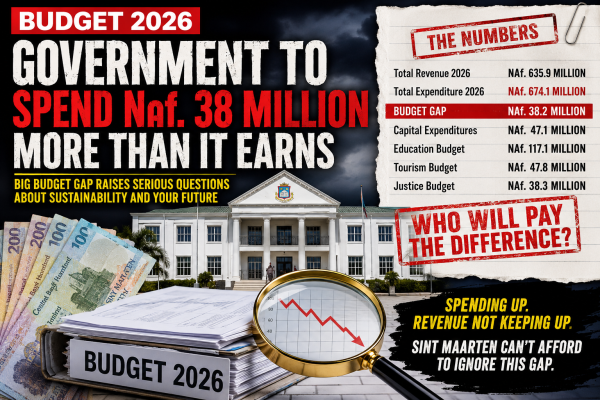 PHILIPSBURG:--- The Government of Sint Maarten is proposing to spend approximately NAf. 674.1 million in 2026 while expecting to collect only approximately NAf. 635.9 million in revenue, creating a financial gap of more than NAf. 38 million that will ultimately have to be financed through borrowing, capital financing or other mechanisms. The figures are contained in the draft 2026 national budget now before Parliament.
The numbers raise a simple but uncomfortable question:
If the government spends more than it earns, who ultimately pays the difference?
According to the budget, expenditure continues to grow across ministries while the government remains heavily dependent on tourism-generated revenue and external economic conditions. While officials describe the budget as a necessary investment in public services, critics may argue it reflects a deeper structural problem: government spending continues to outpace recurring income.
For many households struggling with rising costs of living, the numbers present a stark contrast to the financial realities faced by ordinary citizens.
Families cannot spend more than they earn indefinitely.
Businesses cannot spend more than they earn indefinitely.
Yet the government continues to present budgets that rely on financing to bridge growing gaps.
The 2026 proposal comes at a time when residents continue to raise concerns about crime, healthcare access, road conditions, education quality, immigration enforcement and the overall efficiency of government services.
Despite hundreds of millions of guilders in annual spending, many citizens remain unconvinced that public services are improving at the same pace as government expenditures.
The budget shows Education receiving approximately NAf. 117 million, Tourism approximately NAf. 48 million and Justice approximately NAf. 38 million. Together, these three ministries alone account for more than NAf. 200 million in spending.
The question facing taxpayers is straightforward:
What measurable results will the country receive for this investment?
The budget contains extensive expenditure schedules detailing where money will be spent. What it contains far less frequently are measurable performance targets, allowing taxpayers to determine whether the spending is actually working.
How many crimes should be reduced?
How many students should improve educational outcomes?
How many new tourism jobs should be created?
How many government services should become more efficient?
The answers remain largely absent.
Perhaps most concerning is the country's continued dependence on tourism as its primary revenue driver. The government's financial projections assume continued economic stability and visitor activity. However, recent history has repeatedly demonstrated how vulnerable small island economies can be to external shocks.
A hurricane.
An airline disruption.
A global recession.
A decline in visitor arrivals.
Any one of these events could significantly affect government revenues.
Yet spending commitments continue to increase.
The budget also includes approximately NAf. 47 million in capital expenditures. While investments in infrastructure and development are necessary, questions remain regarding how projects are prioritized and how the government intends to fund long-term obligations arising from those investments.
Parliament now faces perhaps the most important debate of the year.
Not whether the government should spend money.
But whether the government can continue spending beyond its means.
The draft budget outlines where hundreds of millions of guilders will go.
What remains far less clear is how the government intends to eliminate the growing gap between what it earns and what it spends.
Until that question is answered, taxpayers may be justified in wondering whether today's budget balance will become tomorrow's financial burden.
The 2026 Budget may be presented as a roadmap for progress.
For many observers, however, it also reads as a warning.
QUESTIONS PARLIAMENT MUST ANSWER
As Parliament prepares to debate the 2026 Budget, several critical questions emerge from the government's own figures:
1. How will the government finance the NAf? 38.2 million gap?
The budget projects approximately NAf. 635.9 million in revenue against approximately NAf. 674.1 million in expenditures. Parliament must demand a detailed explanation of how the shortfall will be covered and what risks are associated with the financing strategy.
2. Why are spending increases not tied to measurable performance targets?
The budget includes extensive spending allocations but offers few public benchmarks for measuring success. Taxpayers deserve to know what outcomes are expected in exchange for hundreds of millions in public spending.
3. Is the government becoming more efficient or simply more expensive?
Personnel costs and operational expenses continue to consume a significant share of public expenditure. Parliament should determine whether taxpayers are receiving improved services in return for growing government costs.
4. How vulnerable are revenue projections to tourism shocks?
Sint Maarten's economy remains heavily dependent on tourism. A decline in visitor arrivals, airline disruptions, global economic instability or severe weather events could quickly affect government revenues.
5. What portion of the NAf. 47 million capital budget represent new development versus deferred maintenance?
Parliament should seek clarity on which projects create long-term economic value and which projects merely address infrastructure deterioration that should have been addressed years ago.
6. What is the long-term plan to eliminate structural deficits?
The most important question remains unanswered. If the government continues spending more than it collects, when and how will the gap be permanently closed?
The answers to these questions may ultimately determine whether Budget 2026 becomes a roadmap for sustainable growth or a warning sign of deeper fiscal challenges ahead.
SMN News will continue examining ministry-by-ministry allocations and the financial implications of the 2026 Budget in the weeks ahead.
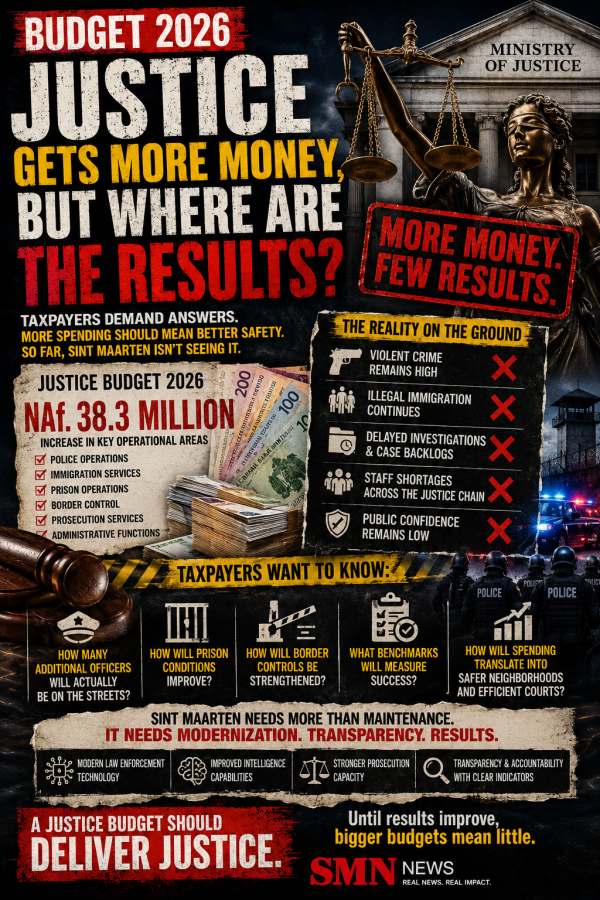 PHILIPSBURG:--- The 2026 Budget presents another significant allocation to the Ministry of Justice, but the real question facing taxpayers is whether Sint Maarten is investing in public safety or merely financing the continuation of long-standing institutional problems.
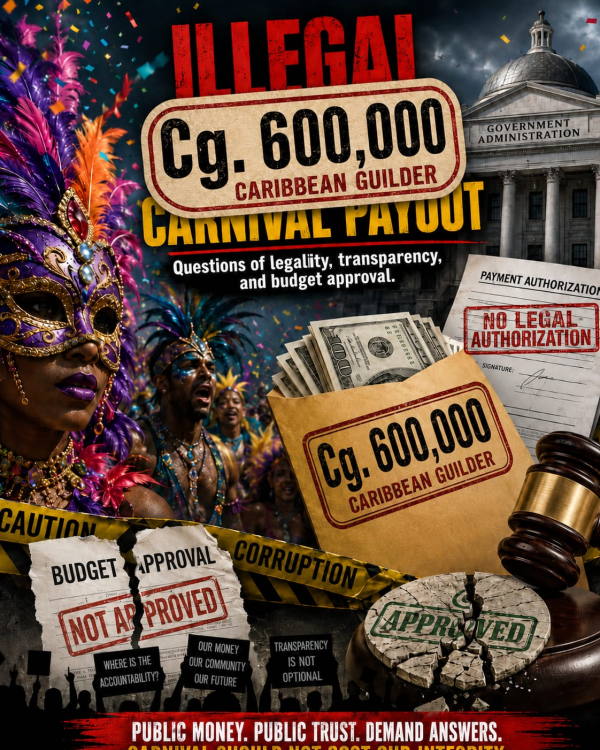 PHILIPSBURG:--- The 2026 budget debate is expected to begin on June 26, but a review of the draft budget documents and the advice issued by the Council of Advice already reveals a series of serious concerns about the government's handling of public finances. Among the most striking findings is a Cg. 600,000 contributions for Carnival that appear in the 2026 budget despite the fact that no such allocation was included in the 2025 budget, and Carnival 2025 has already taken place.
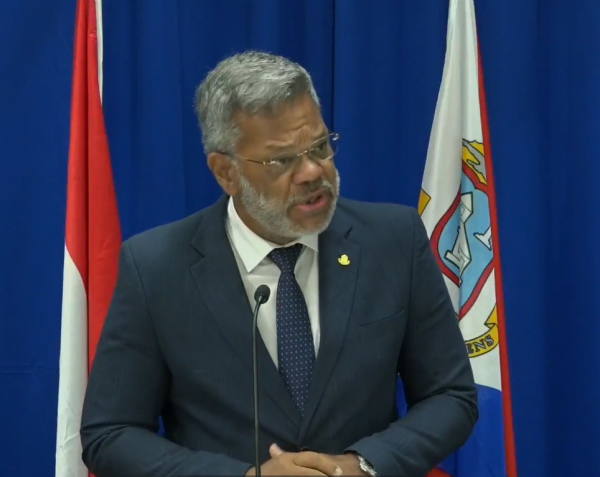 PHILIPSBURG:--- Prime Minister Dr. Luc F.E. Mercelina, in his capacity as Acting Minister of Public Health, Social Development and Labor (VSA), has reaffirmed the Government's unwavering commitment to integrity, transparency, professionalism, and the protection of civil servants throughout the public service.
 WILLEMSTAD:--- The Supreme Court in the United Arab Emirates has approved the extradition of S.A.Q., one of the leaders of the criminal organization No Limit Soldiers (NLS). S.A.Q. has been extradited to Curaçao.