The Council observes risks associated with the screening of justice personnel.

PHILIPSBURG:--- The screening of justice personnel is a measure designed to promote integrity within organizations. In its recently published report, the Law Enforcement Council concludes that the manner in which (potential) justice personnel are screened or re-screened does not always comply with applicable laws and regulations. Its inspection reveals that although all organizations require at least a Certificate of Good Conduct (VOG) for an appointment in accordance with the law, certain organizations deviate from existing screening procedures. Furthermore, mandatory security screenings are not always conducted (in a timely manner) by a number of organizations. This entails risks.


VOGs and security screenings

Integrity within the justice sector is of great importance. Employees work with sensitive information, and citizens must be able to trust that this is handled carefully and reliably. For this reason, the Council assessed the status of screening and re-screening of personnel within the justice sector. The Council specifically examined the VOG and security screenings.

Although the process for the Certificate of Good Conduct (VOG) is in place, the Council notes that some organizations question its added value due to the type of data on which it is currently based. As a result, some organizations are deviating from existing screening procedures and taking a creative approach to gain more insight into applicants’ backgrounds, for example, by making informal inquiries within their own networks. This is because the investigation is limited to the procedure of requesting criminal records, even though legislation, regulations, and policies allow for greater flexibility in gathering information, including police records.

While the Council can somewhat understand that organizations devise solutions in practice to obtain more relevant information given the potential risks, the Council believes that this also entails the necessary (integrity) risks for the organization. Even though a number of organizations argue that the absence of the aforementioned data is perceived as unacceptable due to the potential security and integrity risks they face, organizations — just like everyone else— must comply with the law. The Council further notes that the sharing of data within the Kingdom for the issuance of a Certificate of Good Conduct (VOG) is not yet properly regulated by law.

A security screening is mandatory for specific positions. The screening can only be conducted if a position has been officially designated as a so-called position of confidence. However, due to changes in job descriptions and the lack of formal designations, some security screenings cannot currently be carried out. Furthermore, security screenings are not always repeated every five years, even though the law requires this. Here too, the Council highlights the resulting risks.


Urging action

The Council believes that action must be taken as soon as possible to ensure that a number of organizations are in compliance with the law. These are specifically the Coast Guard, the IGD, and the KPSM. This is to ensure that their personnel can undergo a (repeat) security screening, where necessary, and in accordance with the law. In addition, the designation of confidential positions for the Coast Guard has yet to take place.

To achieve the necessary improvements, the Council has made four concrete recommendations to better safeguard the integrity and reliability of justice personnel.

Council website 

The full inspection report and all other publications of the Council are available digitally on the website: https://www.raadrh.com/  
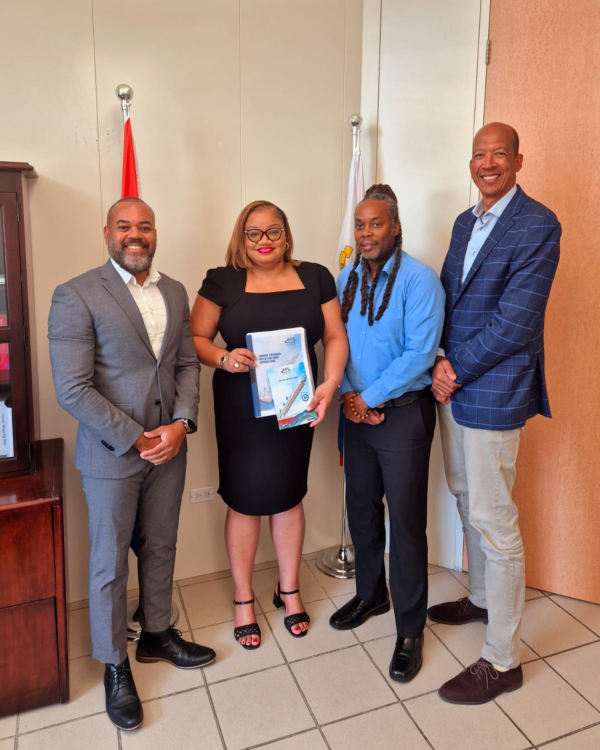

FOR IMMEDIATE RELEASE APS Announces Third Consecutive Pension Increase and Surpasses Cg 1 Billion in Assets.

marinkaps18062026PHILIPSBURG:--- On June 11, the Algemeen Pensioenfonds Sint Maarten (APS) presented its clean audit report to the Minister of Finance, further underscoring the fund’s strong financial performance and long-term stability.
APS has announced a 0.92% pension increase, marking the third consecutive year that pensioners will benefit from indexation. The increase is made possible by the fund’s healthy coverage ratio of 116.23% and is based on consumer price index data. The adjusted pension amount is expected to be paid in July 2026, with retroactive effect to January 2026.

The ability to provide consecutive pension increases reflects APS’s continued commitment to preserving the purchasing power of pensioners while maintaining the financial strength of the fund.

While APS remains in a strong position, future indexation will always depend on the fund’s financial health, economic conditions, and investment performance. APS has also reached a significant milestone, with total assets under management now exceeding Cg 1 billion. In addition, the fund recorded a positive financial result of approximately Cg 27 million for 2025, driven primarily by investment income and disciplined portfolio management.

Honorable Minister of Finance Marinka Gumbs welcomed the continued positive results, noting the importance of a strong and sustainable pension system to the financial security of retirees and the overall resilience of Sint Maarten.

“These results demonstrate the importance of prudent financial management and a long-term approach to safeguarding pension benefits. A strong APS benefits not only today’s pensioners, but also the generations that will depend on the fund in the future,” said Minister Gumbs.

The Minister further noted that APS is exploring opportunities to strengthen and expand the pension system. Following a proposal by the Minister, APS is examining the possibility of increasing participation by government-related entities to further enhance the fund’s long-term sustainability and resilience.

“The ability to provide a pension increase for a third consecutive year while surpassing the milestone of Cg 1 billion in assets is a significant achievement for APS. These results reflect the confidence of our participants, the dedication of our team, and the strength of the governance and investment policies that guide the fund.

While we are proud of the progress achieved, we remain focused on the future. APS continues to identify opportunities to strengthen the pension system, expand participation, and ensure that the fund remains resilient in an evolving economic environment. Our commitment extends not only to today’s pensioners, but also to the generations of public servants who will rely on APS in the years ahead.”

APS also continues to contribute to ongoing initiatives aimed at modernizing the regulatory and investment framework for pension funds within the monetary union, ensuring that pension funds remain well-positioned to navigate changing economic conditions while continuing to deliver value to participants and retirees.

Through sound governance, responsible investing, and prudent financial management, APS remains committed to protecting the retirement security of its members and delivering sustainable benefits for the people of Sint Maarten.

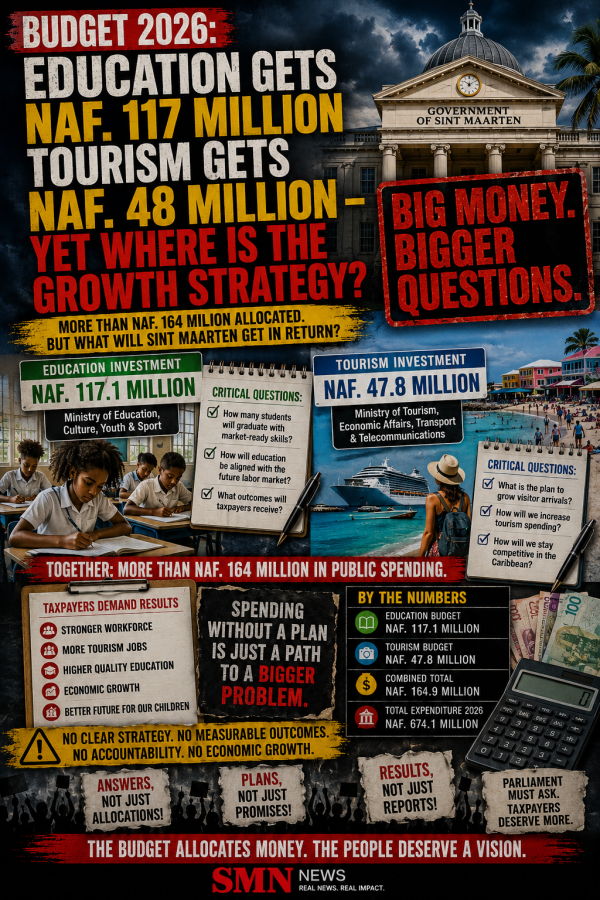
Budget 2026: Education gets Naf. 117 million, Tourism Naf. 47.8 million — But where is the growth strategy?

~More than NAf. 164 million allocated to two critical Ministries as Questions mount over outcomes and economic vision.~

budget202617062026PHILIPSBURG:--- The Government's 2026 Budget reveals a striking reality about Sint Maarten's priorities: more than NAf. 164.9 million will be allocated to the country's Education and Tourism ministries, yet the budget provides limited evidence of how those investments will translate into measurable economic growth, workforce development, or national competitiveness.

According to the draft 2026 Budget, the Ministry of Education, Culture, Youth and Sport is allocated approximately NAf. 117.1 million, making it one of the largest recipients of government funding. The Ministry of Tourism, Economic Affairs, Transport and Telecommunications will receive approximately NAf. 47.8 million. Together, the two ministries account for nearly one-quarter of the country's ordinary expenditure budget.
The figures immediately raise an important question:
What exactly is Sint Maarten getting in return for this investment?
Education continues to absorb one of the largest portions of public spending year after year. Yet the budget provides little indication of a transformative strategy to prepare students for the realities of a rapidly evolving economy.
Across the island, employers continue to report difficulty finding qualified workers. Businesses increasingly seek employees with digital skills, technical expertise, language proficiency, and specialized vocational training. Yet there is limited evidence within the budget of a comprehensive plan to aggressively align educational outcomes with labor market demands.
The result is a growing disconnect between education and employment.
Taxpayers are entitled to ask how many students will graduate with market-ready skills, how many young people will enter high-demand professions, and how the government intends to measure success beyond simply funding the system.
The concerns become even more pronounced when examining Tourism.
Tourism remains the backbone of Sint Maarten's economy. Government revenues, business activity, employment opportunities, and consumer spending all depend heavily on the strength of the tourism sector. Yet despite receiving approximately NAf. 47.8 million, the budget offers limited detail regarding how the government intends to strengthen Sint Maarten's competitive position in an increasingly crowded regional marketplace.
Across the Caribbean, competing destinations are investing heavily in destination branding, digital tourism infrastructure, sustainability initiatives, airlift expansion, and improvements to the visitor experience.
The tourism industry is evolving rapidly.
Success can no longer be assumed.
It must be strategically earned.
Yet the most significant concern may be what appears to be missing altogether: a clear connection between education and tourism.
In a small island economy, the two sectors should be working hand in hand.
Schools should be preparing future hospitality managers, aviation professionals, entrepreneurs, information technology specialists, marketers, and tourism executives.
Training programs should be aligned with industry needs.
Students should be leaving classrooms with pathways into the country's most important economic sectors.
Instead, the budget appears to fund two separate systems without clearly demonstrating how they contribute to a unified national development strategy.
At a time when the government plans approximately NAf. 674.1 million in overall expenditures, taxpayers deserve more than spending allocations.
They deserve results.
How many new tourism jobs will be created?
How much visitor spending growth is expected?
How many students will graduate with workforce-ready skills?
How will the government measure performance?
How will these investments strengthen the economy over the next decade?
The budget allocates the money.
What remains far less clear is whether it provides the vision.
And for a country seeking sustainable growth in an increasingly competitive region, that may be the biggest concern of all.

Ombudsman expresses serious concerns about limited access to the registration process at Censo.

ORANJESTAD, ARUBA:--- The Ombudsman of Aruba, Ms. Jurima Bryson, LL.M., has received an increasing number of complaints and reports from individuals experiencing difficulties obtaining an appointment to register at the Civil Registry Office (Censo).

Based on the complaints received, many citizens are unable to secure an appointment within a reasonable period to register in Aruba’s civil registry. According to the Ombudsman, there appears to be a structural imbalance between the number of registration requests and the available processing capacity.

The issue affects not only individuals who have recently obtained a residence permit, but also Arubans returning to Aruba after living abroad who need to register again. As a result, citizens are faced with long waiting periods and uncertainty regarding when they will be able to complete their registration.

The consequences are significant. Registration in the civil registry is an essential requirement for access to various services. Without registration, citizens may encounter difficulties in obtaining access to healthcare (AZV), education, social services, employment, banking services, insurance, and housing.
The Ombudsman considers it undesirable that citizens, as a result of Censo’s capacity and organizational challenges, are unable to access an essential public service within a reasonable timeframe. According to the Ombudsman, government services should be organized in such a way that citizens can effectively exercise the rights to which they are entitled.

In light of this situation, the Ombudsman sent a letter of concern to the Minister of Justice and Social Affairs, Mr. Arthur Dowers, LL.M. on June 15, 2026.

As an independent and impartial institution, the Ombudsman has issued several recommendations aimed at improving the accessibility, timeliness, and continuity of the registration process. These include reducing existing backlogs, expanding appointment opportunities, strengthening processing capacity, and improving information provided to the public.

More information on this matter can be found in the Ombudsman’s letter of concern regarding access to the registration process at the Civil Registry Office (Censo). The full letter is available on the Ombudsman’s website at www.ombudsman.aw/en/publications/.

The St. Maarten Chamber of Commerce & Industry addresses unauthorized container on Pelican Park Property

foodtruck17162026PHILIPSBURG: --- The St. Maarten Chamber of Commerce & Industry (COCI) wishes to inform the public of an incident involving an unauthorized container that was placed on the Pelican Park property without the Chamber’s knowledge or approval.
COCI became aware of the matter through reports circulating on social media indicating that the container contained spoiled meat and was emitting a strong, offensive odor, posing a potential public health concern.
Upon learning of the situation, the Chamber acted promptly to address the issue. The owner of the container was contacted and requested to take responsibility for its removal and the cleanup of the affected area. While efforts were made to have the responsible party resolve the matter, the Chamber ultimately ensured that the container was removed and that the area was thoroughly cleaned and sanitized in the interest of public health, safety, and the preservation of the Pelican Park property.
COCI wishes to make it unequivocally clear that stricter measures will be enforced regarding the use of its property. Effective immediately, any containers, equipment, vehicles, materials, or other items placed on the Pelican Park property without the Chamber’s express authorization will be subject to immediate removal at the owner’s expense, where applicable.
The Chamber further reminds the public that no individual, business, organization, or third party has the authority to grant permission to place any object on Pelican Park property. Authorization for the use of Chamber property may only be granted directly by the St. Maarten Chamber of Commerce & Industry.
COCI remains committed to maintaining a safe, clean, and orderly environment for the business community and the general public. The Chamber appreciates the cooperation of all stakeholders in respecting and adhering to these requirements.

More Articles ...


Subcategories