




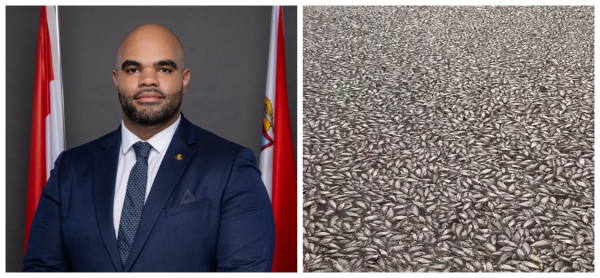
 PHILIPSBURG – The Ministry of Public Housing, Spatial Planning, Environment and Infrastructure (VROMI) is exploring alternative methods to accelerate the cleanup of the thousands of dead fish floating in the canal (floodgate) along A.T. Illidge Road leading to the Great Salt Pond, after the unprecedented environmental incident overwhelmed the island's available resources.
VROMI Minister Patrice Gumbs Jr. said discussions with key stakeholders were scheduled for Monday evening to develop a more effective cleanup strategy, including the possible deployment of small boats and nets to assist with removing the dead fish from the water before heavy machinery continues its work on Tuesday.
According to the minister, St. Maarten simply does not possess the specialized equipment needed to efficiently handle a fish kill of this magnitude.
"We are looking at alternative solutions because the equipment required for a cleanup of this scale is not available locally," Gumbs explained.
While St. Maarten has experienced fish kill incidents in the past, the minister described this event as the largest ever recorded on the island.
The massive die-off was discovered on Saturday morning in the canal connecting to the Great Salt Pond. The government immediately mobilized a contractor, who currently has two excavators (bakhos) working at the site. However, progress has been slow because the specialized screening buckets required for excavators to efficiently separate fish from water and mud are not available on the island.
As a result, the cleanup operation has proven far more challenging than initially anticipated.
"The intention is to meet this evening to work out a plan to clean the area up as quickly as possible," the minister said.
The prolonged presence of the decomposing fish has raised concerns among nearby residents and business owners, particularly because of the strong odor emanating from the canal.
The Ministry is therefore urging people living and operating businesses in the vicinity of A.T. Illidge Road and the Great Salt Pond to take the necessary precautions while cleanup efforts continue.
Government hopes that by combining mechanical equipment with smaller vessels and manual netting operations, crews will be able to remove the dead fish more efficiently and minimize the environmental and public health impact of what has become St. Maarten's largest recorded fish kill.