




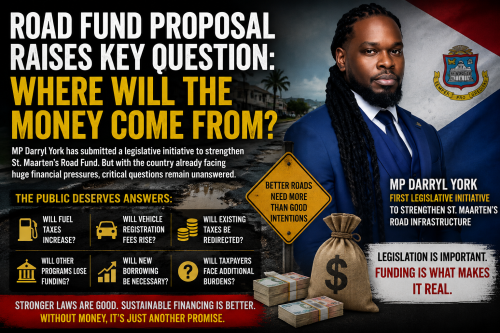
 PHILIPSBURG:--- National Alliance Member of Parliament Darryl York has submitted his first legislative initiative to Parliament, proposing reforms to strengthen St. Maarten's Road Fund with the stated goal of creating a sustainable financing mechanism for road maintenance and infrastructure development. The proposal has been presented as a long-term solution to the country's deteriorating road network and recurring maintenance backlog.
The objective itself is difficult to dispute.
Residents, businesses and visitors have long complained about the state of the island's roads. Damaged pavement, potholes, inadequate drainage and inconsistent maintenance have become recurring issues affecting motorists, public transportation, tourism and emergency services.
York argues that the answer is to place infrastructure financing on a stronger legislative footing rather than leaving it subject to annual budget decisions. His proposal reportedly draws on recommendations made by the General Audit Chamber regarding infrastructure-related revenues and the management of the Road Fund.
However, while the initiative addresses how road funding should be managed, it leaves an equally important question demanding public debate:
Where will the money actually come from?
That question is particularly relevant given St. Maarten's current financial reality.
Government is already struggling to balance its annual budget while simultaneously facing demands for increased spending on healthcare, education, justice, prison construction, police, infrastructure, waste management, social programs and climate resilience.
Simply creating stronger legislation does not create new revenue.
Unless additional funding sources are identified, every guilder dedicated to a Road Fund must come from somewhere else.
Will motorists face higher road taxes?
Will vehicle registration fees increase?
Will fuel taxes be raised?
Will a portion of existing taxes be diverted from other government priorities?
Will new borrowing become necessary?
Or will government simply redistribute money already committed elsewhere?
None of these questions are insignificant, particularly at a time when residents continue to face high utility bills, inflation and rising living costs.
The proposal also arrives while government itself continues to finance major infrastructure works through annual budget allocations, capital investments and external financing.
If the Road Fund requires guaranteed annual contributions, Parliament will ultimately need to determine what existing expenditure will be reduced to accommodate those commitments.
Legislation without sustainable financing risks becoming another law with good intentions but limited practical impact.
History provides several examples where dedicated funds have struggled because revenue streams proved insufficient or because governments facing financial pressure redirected available resources to more immediate priorities.
York deserves credit for moving beyond criticism and placing a legislative proposal before Parliament.
Introducing legislation is one of the core responsibilities of Members of Parliament, and proposals aimed at improving long-term infrastructure financing deserve careful consideration rather than political dismissal.
But responsible legislation must answer not only what government should do, but how it will pay for it.
As Parliament begins examining the proposal, the debate should extend beyond road maintenance alone.
The public deserves clear answers.
How much money will the proposed Road Fund require annually?
What are the projected revenue sources?
Will taxpayers face additional financial burdens?
Will existing government programs lose funding?
Can the current national budget realistically sustain another dedicated financing obligation?
Until those questions are answered with concrete financial projections, the Road Fund proposal remains only one half of the equation.
Improving legislation is important.
Funding it is what ultimately determines whether the country's roads improve—or whether the initiative becomes another well-intentioned law without the financial means to deliver the promises it makes.