




~Doran and Lacroes say Parliament wanted answers on Ryan Gumbs' case, not excuses, as they question deportation decision, outdated laws and government priorities.~
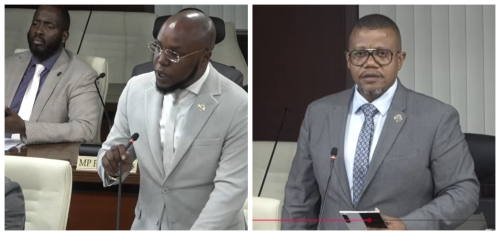 PHILIPSBURG:--- The urgency surrounding St. Maarten's worsening road safety crisis quickly evolved into a wider debate over accountability within the justice system on Tuesday, as Members of Parliament Egbert Jurendy Doran and Francisco Lacroes challenged Justice Minister Nathalie Tackling over the government's handling of the fatal June 11 traffic collision that claimed the life of Ryan Gumbs.
Although the Minister devoted much of her opening presentation to accident statistics, police capacity and legislative shortcomings, both MPs argued that Parliament had convened the urgent meeting because the public was demanding answers about the controversial decision to deport the suspect involved in the fatal collision before the criminal case reaches trial.
Their interventions reflected growing public frustration over transparency, coordination within the justice chain, and whether victims' families can continue to have confidence in the administration of justice.
Doran: "I don't want good answers, I just want the truth."
Opening the first round of questions, MP Egbert Jurendy Doran said he had expected a very different tone from the Minister.
"You mentioned that good answers take time," Doran told the Minister. "With all due respect, I don't want good answers. I just want the truth. The truth shouldn't take time."
Doran immediately highlighted what he described as a contradiction between the Minister's presentation, and an official statement issued by the Prosecutor's Office.
The Minister had stated that one of the fatal crashes involved an overtaking maneuver. However, Doran quoted directly from the Prosecutor's Office, which stated that investigators had not found evidence supporting public claims that the suspect overtook vehicles prior to the collision.
He therefore asked the Minister what information she possessed that prosecutors apparently did not.
"What information do you have that the Prosecutor's Office does not have?" he asked.
"And how did that influence the eventual deportation decision?"
"Justice must not only be done, but it must also be seen."
Doran stressed repeatedly that Parliament was not attempting to determine guilt or innocence, a responsibility that belongs exclusively to the courts.
Instead, he said Parliament's constitutional responsibility is to ensure that the legal process functions properly and that government institutions coordinate effectively.
"This debate extends beyond a single incident," Doran said.
"It is about whether the people of St. Maarten can continue to have confidence in our justice system."
He warned that the perception left with the public is that someone connected to a fatal traffic collision was permitted to leave the jurisdiction before the justice process had fully run its course.
"The justice system must ensure that victims never feel administrative procedures were given greater priority than accountability."
"Justice must not only be done, it must also be seen to be done."
Dozens of legal questions
Doran then presented one of the most extensive series of legal questions heard in Parliament in recent months.
Among the issues he asked the Minister to clarify were:
- When does a fatal traffic accident become a criminal investigation?
- Who determines whether a case involves negligence, reckless driving or manslaughter?
- Who decides whether a suspect remains in custody?
- What role does Immigration play when a criminal investigation remains active?
- Is confirmation required from prosecutors before someone connected to a fatal collision can be deported?
- What authority does the Minister of Justice possess to intervene if deportation could prejudice a criminal investigation?
- Are there legislative gaps creating uncertainty between immigration enforcement and criminal prosecutions?
Criminal Code already provides penalties
Doran also questioned the Minister's repeated references to outdated legislation.
Quoting Articles 2:284 and 2:286 of the Criminal Code, he pointed out that St. Maarten law already provides prison sentences for causing death through negligent or reckless driving and imposes even heavier penalties where alcohol or intoxicating substances are involved.
He asked how investigators determine whether those provisions apply, particularly in cases where a driver leaves the scene before police arrive, potentially preventing investigators from obtaining evidence of intoxication.
He further questioned whether current investigative procedures sufficiently protect the collection of evidence necessary to prosecute such cases.
Deportation policy questioned
One of Doran's strongest criticisms centered on deportation policy.
He asked whether the Ministry currently permits deportations while criminal investigations remain active—not only in fatal traffic cases, but also in murders, armed robberies and other serious crimes.
He requested statistics covering the past three years and asked what safeguards exist to ensure suspects remain available for prosecution if removed from the island.
Ultimately, he said Parliament's objective was restoring confidence in the justice system.
"If today's deliberation reveals gaps in our laws, our policies or coordination between our institutions, then it is our responsibility to address them."
"The people of St. Maarten deserve a justice system that is transparent, accountable and worthy of their trust."
Lacroes: "I became irritated"
MP Francisco Lacroes echoed many of Doran's concerns, admitting he became increasingly frustrated while listening to the Minister's presentation.
"I thought this meeting would have gone differently," Lacroes told Parliament.
"I sat here listening and I somewhat got very irritated."
Although describing his working relationship with Tackling as positive, Lacroes said the presentation focused heavily on budgetary problems and legislative shortcomings instead of addressing why Parliament had requested an urgent meeting.
"Why are we only hearing this now?"
Lacroes questioned why Parliament had never previously been informed that a completed revision of the Traffic Ordinance remained stalled because government had failed to pay the consultant who prepared it.
"If the Minister has done so, to whom?" he asked.
"I have never heard this before."
He argued that ministers should proactively inform Parliament whenever serious operational obstacles arise rather than waiting until a crisis forces the discussion.
"It cannot be that after something happens, this information comes forward."
"This is a problem of life and death."
"This should have been in this budget."
Public outrage forced answers
Lacroes argued that the real reason Parliament was meeting was not simply because another fatal accident had occurred.
"We are here today because of what transpired."
"The family felt robbed and cheated."
He went further, suggesting that without public pressure generated by Members of Parliament and widespread social media attention, the public might never have received an explanation from the Prosecutor's Office.
"If MP Lyndon Lewis and I did not make any statements on Facebook, this would have been another case that would have gone straight under the table."
"The only reason we got any response from the Prosecutor's Office was that noise was made."
Questions over deportation
Lacroes said he found it difficult to believe the Minister would knowingly authorize deportation while a criminal investigation remained active.
He asked:
- Was the Minister aware that a criminal investigation remained pending before signing deportation documents?
- Does St. Maarten have an extradition treaty with Jamaica?
- How many convicted persons have ever returned after being deported?
- How many offenders have been deported before serving their sentences during the past five years?
He maintained that if legislation prevented prosecution under these circumstances, government should already have introduced amendments long ago.
"We are co-legislators," he reminded Parliament.
"The easiest route to deal with something like that would have started in Justice."
Scooter crisis
Lacroes also shifted attention toward the wider scooter problem.
He questioned why authorities continue removing illegal scooters from the roads while new ones rapidly replace them.
He renewed calls for tighter controls over scooter imports, licensing and sales.
Drawing comparisons with Grenada and Colombia, he noted strict helmet compliance and other enforcement measures overseas and asked why similar standards cannot be achieved in St. Maarten.
"At some point the government needs to decide if you cannot handle this responsibly, we will have to pull back on it until we can find a way to deal with this."
"People are dying."
Appeal for greater transparency
Concluding his remarks, Lacroes urged Tackling to communicate with Parliament before controversies escalate.
"The Minister could also request a meeting with Parliament," he suggested.
"If this is a pending case, then tell us that."
"Tell the public."
"Tell the families."
He said uncertainty surrounding the government's handling of the Ryan Gumbs case has fueled speculation that could have been avoided through earlier communication.
"It is not only about what took place."
"It is the fact that people don't know what is happening that causes the confusion and causes the frustration."
Lacroes ended emotionally, saying he personally knew the victim's family and warned that today's tragedy could become anyone's tomorrow.
"Today it is them."
"Tomorrow it could be my family."
"Tomorrow it could be the Minister's family."
"And that is what everyone needs to hear."