




Opposition and coalition members find common ground on reform, while Irion calls for publication of Parliament attendance records
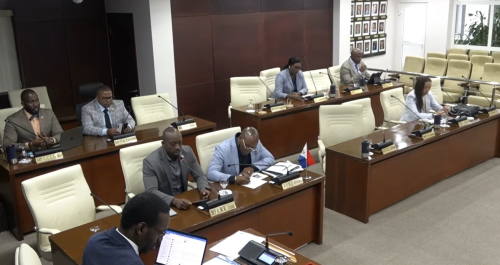 PHILIPSBURG:--- What began as a continuation of Parliament's Central Committee meeting on the 2026 draft budget quickly evolved into a spirited debate over how Parliament conducts one of its most important constitutional responsibilities, with Members from both the coalition and opposition agreeing that the current budget process requires significant reform.
The discussion centered on newly introduced procedures requiring Members of Parliament to submit all budget questions in writing by July 2, after which the questions will be compiled into a Central Committee report, ratified on July 6, and forwarded to Government. Ministers will then provide written responses before the public budget debate, where Members can seek clarification and engage in political debate.
While the procedure is intended to streamline the budget process, several Members questioned whether it would actually eliminate duplication or simply postpone it.
Coalition MP Ludmila de Weever was among the first to weigh in, saying the discussion should focus on improving Parliament's efficiency rather than repeating the same questions in multiple meetings.
"There are set rules for handling the budget," De Weever said, explaining that too often identical questions are asked in Central Committee and then repeated again during the public meeting because the initial responses are insufficient. She argued that the duplication wastes time for Members, civil servants and ministers alike.
"I wanted to bring up... changing the way we work and working a little bit more efficiently," she said, adding that Parliament should have a broader dialogue about modernizing its procedures for future budgets.
She later clarified that her comments were not aimed at the current July timeline but at the overall structure of budget debates.
"We literally have a Central Committee meeting that lasts the same amount of time as a public meeting... the same questions are posed, the same answers are given, and it's just not an efficient way of working."
Opposition MP Egbert Jurendy Doran largely agreed with the objective but questioned whether the revised procedure would actually solve the problem.
Doran noted that once Government submits written responses after July 6, Members would still be forced to revisit many of the same issues during the public meeting because they would not have an opportunity to clarify unclear responses beforehand.
"I thought that changing up the process... would have included responses from Government so that clarification could take place before the public meeting. Otherwise, we'll have the same situation MP De Weever is talking about where we're asking the same questions again."
Although he acknowledged the Chair's explanation, Doran concluded that the revised system still appeared "a little less efficient."
MP Francisco Lacroes also sought clarification, asking whether ministers would return to Parliament after submitting their written answers.
When informed that ministers would not appear again until the public meeting, Lacroes pointed out that any unclear written responses would inevitably force Members to repeat the same questions during the open debate.
"So basically, what MP De Weever is saying is exactly that," Lacroes observed after receiving the Chair's explanation.
Perhaps the strongest criticism came from opposition MP Ardwell Irion, who said Parliament's procedural debates have become confusing both for Members and the public.
"The procedure honestly is becoming a joke to me, and I think even the rest of the people in St. Maarten," Irion remarked, criticizing what he described as inconsistent application of parliamentary rules and differing treatment between coalition and opposition Members.
Irion said if Parliament intends to make the new process the standard for handling legislation, it should be applied consistently to every major piece of legislation moving forward, including future tax reforms and other national ordinances.
He argued that once ministers present legislation, Members should submit written questions, receive written answers, and reserve substantive debate for the public meeting.
"I really hope that in two weeks, in August, September, I don't hear members of the coalition say, 'No, let's have another discussion in Central Committee.' It should be the same way going forward," he said.
Irion also raised another issue that resonated with the public: parliamentary attendance.
He said he hopes Parliament will begin publishing attendance records so citizens can clearly see which Members consistently report for duty and actively participate in meetings, and which do not.
According to Irion, taxpayers deserve to know which elected representatives are regularly present to perform the work for which they receive a public salary.
The discussion highlighted an unusual point of consensus inside Parliament. While Members disagreed on the mechanics of the new procedure, both coalition and opposition MPs acknowledged that the current budget process often results in repetitive questioning, unnecessary duplication of work and longer parliamentary sessions.
The Chair ultimately maintained the revised process, reminding Members that written questions must be submitted no later than July 2, with the Central Committee expected to ratify its final report on July 6 before forwarding it to Government for written responses. Those responses will then form the basis of the public debate on the 2026 national budget.