




~Finance Minister Marinka Gumbs says St. Maarten is moving from line-item spending to policy-based budgeting, but the numbers show a government machinery growing fast.~
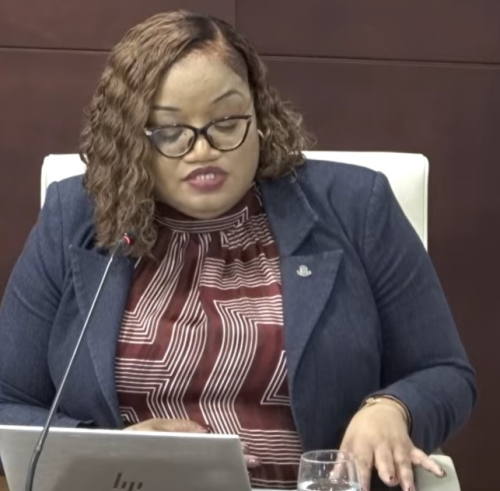 PHILIPSBURG:--- Finance Minister Marinka Gumbs placed a Cg 647 million revenue budget before Parliament on Friday, calling it a historic shift in how St. Maarten manages public money, while also admitting that the budget was again submitted later than it should have been.
The 2026 draft budget projects Cg 647 million in revenue against Cg 636 million in operating expenditure, leaving the government with a projected operational surplus of Cg 11 million. Compared to the 2025 budget, revenues increase by Cg 61 million from Cg 586 million, while expenditure increases by Cg 58 million from Cg 577 million.
The Minister described the budget as the first national budget prepared under a policy-based budgeting framework, moving away from the old system where the government simply listed what it would spend on salaries, rent, supplies, and utilities. Under the new system, ministries must explain why money is being spent, what outcomes are expected, and how Parliament can measure delivery.
Gumbs told Parliament that St. Maarten is “shifting from inputs to impact,” arguing that taxpayers must be able to see a direct link between the taxes they pay and the improvements government claims it will deliver.
But behind the language reform, the figures show a government budget that is expanding rapidly.
Taxes remain the backbone of government revenue, with Cg 478 million projected for 2026, representing 74 percent of total income. Other revenue, including project funds, is projected at Cg 91 million, or 14 percent. Fees and concessions are estimated at Cg 62 million, while licenses account for Cg 16 million.
On the expenditure side, personnel costs show one of the most significant increases. Personnel expenditure rises from Cg 223 million in 2025 to Cg 279 million in 2026. Goods and services jump from Cg 127 million to Cg 167 million. Subsidies remain high at Cg 109 million, compared to Cg 107 million in 2025. Social provisions decline from Cg 42 million to Cg 36 million, while interest remains heavy at Cg 26 million.
The increase in personnel is linked to filling vacancies, a 2.5 percent salary indexation, and project-related staffing. The increase in goods and services is attributed mainly to temporary TWO project-related operational spending, which the government says should decline after 2027.
Education, Culture, Youth, and Sport receive the largest ministry allocation at Cg 126 million, representing 21 percent of the ministerial budget. Justice follows with Cg 114 million, or 19 percent. VSA receives Cg 109 million, Finance Cg 91 million, General Affairs Cg 90 million, TEATT Cg 41 million, and VROMI Cg 37 million.
That means the three largest spending areas — Education, Justice, and VSA — together account for Cg 349 million, more than half of the consolidated ministerial budget of Cg 608 million.
The first-quarter results for 2026 gave the government a stronger starting position. For Q1, the government recorded Cg 171 million in revenue and Cg 132 million in expenses, producing a Cg 39 million result. Compared to the 2026 budget projection for the same period, revenue was Cg 9 million higher and expenses were Cg 27 million lower.
The higher revenue was driven largely by stronger tax collection, especially profit tax. Expenses were lower due to Cg 10 million less in personnel spending and Cg 14 million less in goods and services. Compared to Q1 2025, revenue increased by Cg 8.8 million, while expenses increased by Cg 7.3 million, mainly due to Cg 6.1 million more in payroll expenses.
Gumbs acknowledged that the late submission of the budget remains a serious problem. She said she would not offer excuses or shift blame, but would take responsibility for strengthening the system. She said the 2027 budget process has already started earlier than in previous years, with ministries engaged in advance to avoid another late submission.
The multi-year outlook projects continued surpluses: Cg 11 million in 2026, Cg 8 million in 2027, Cg 15 million in 2028, and Cg 17 million in 2029. However, the 2027 outlook also shows revenue rising to Cg 670 million and expenditure climbing to Cg 662 million.
Notably, the planned tourist tax, estimated at approximately Cg 18 million, is not included in the 2027 revenue projections because the legislative process has not yet been completed.
The central question for Parliament is whether this new budget system will truly produce measurable results, or whether St. Maarten will simply continue spending more money under a new name.
For years, budgets have come late, annual accounts have lagged, and Parliament has been forced to debate financial plans without always having the full picture of past performance. Gumbs is now promising a break from that pattern.
The numbers give her government room to claim progress. The challenge is proving that Cg 647 million will not simply finance a bigger bureaucracy, but produce better schools, safer communities, stronger healthcare, functioning infrastructure, and real accountability.