




~Opposition says new process silences debate, reduces transparency and helps Government fast-track late 2026 Budget~
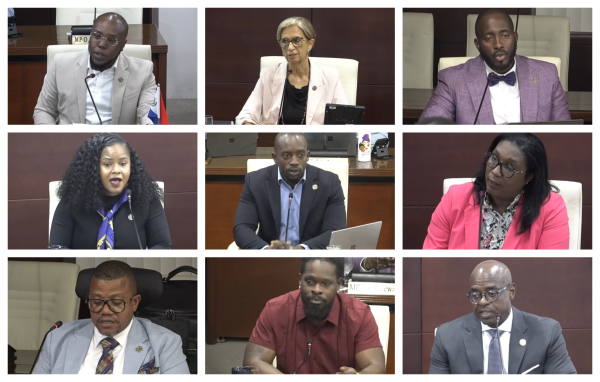 PHILIPSBURG:--- Before Minister of Finance Marinka Gumbs had the opportunity to present a single figure from the 2026 national budget, Parliament erupted into one of its most heated procedural battles in recent months, with Opposition Members accusing Chairlady Sarah Wescot-Williams of attempting to fundamentally change the way Parliament scrutinizes the country's finances.
The dispute was not over taxes, spending, or government priorities. Instead, it centered on how Parliament itself should examine the most important piece of legislation presented each year—the national budget.
What began as a procedural proposal quickly evolved into a fierce constitutional and political debate over parliamentary oversight, transparency, accountability, and the rights of elected Members of Parliament.
At the center of the controversy was Chairlady Wescot-Williams' proposal to require Members of Parliament to submit all budget questions in writing by July 2, have Parliament ratify those questions on July 6, and then forward them to Government for written responses before the public budget debate begins.
Under the proposed timetable, Government would have approximately two weeks to answer the questions, allowing Parliament to reconvene during the July recess if the responses are delivered on time.
For the Opposition, however, the proposal represented far more than a scheduling adjustment.
They argued it fundamentally alters decades of parliamentary practice while reducing opportunities for ministers to publicly defend their budgets before the people of St. Maarten.
Doran: Parliament should not experiment with the country's Most important law
The first major objection came from MP Egbert Jurendy Doran, who reminded Parliament that faction leaders had already discussed the handling of the budget during an earlier meeting and had left with the understanding that another approach would be followed.
Instead, Members were now presented with an entirely different proposal.
Doran questioned whether Parliament was attempting to solve the government's administrative shortcomings by weakening parliamentary scrutiny.
He revealed that he still has seven to eight unanswered parliamentary letters, some dating back more than a year, and questioned why Members should believe the Government would suddenly respond promptly to hundreds of detailed budget questions.
"We're talking about a Budget that is already super late," Doran argued.
According to him, removing the traditional opportunity for Members to seek immediate clarification from ministers amounts to "a gross infringement" of parliamentary rights.
He warned that Parliament was effectively using the country's most important legislation as a "pilot project."
Later in the debate, Doran again challenged the Chair, questioning how Members could raise issues omitted from the Minister's presentation if they were only permitted to ask clarification questions before submitting written questions.
He also argued that the proposal appeared designed to fast-track debate while limiting public discussion.
Lewis: Don't Change the Rules for the National Budget
Opposition MP Lyndon Lewis echoed many of those concerns.
While supporting efficiency in principle, Lewis said the annual budget is not the legislation on which Parliament should begin experimenting with new procedures.
He pointed to recent parliamentary meetings where even the Prime Minister failed to answer questions posed by Opposition MPs and argued that reducing opportunities for direct exchanges would only weaken Parliament's oversight role.
Lewis later admitted he was confused by the proposed sequence, asking how Members could submit meaningful questions before hearing detailed presentations from each ministry.
He also criticized the government's poor record in responding to parliamentary correspondence, revealing that he still has approximately 50 unanswered questions submitted to the Minister of Justice.
"The people's business should be taken seriously," Lewis declared.
Irion: Parliament Exists to Speak
Perhaps the most philosophical criticism came from MP Ardwell Irion, who reminded colleagues that the very word Parliament means "to speak."
Irion suggested Government appeared increasingly reluctant to publicly debate legislation, warning that Parliament was now considering limiting discussion on the country's "heaviest" piece of legislation.
He revealed that he had already written to the Chair warning that the proposal contradicted previous parliamentary reasoning regarding legislative procedures.
Irion also argued that Members currently benefit from an informal second opportunity during Central Committee meetings to obtain clarification from ministers—an opportunity he believes would effectively disappear under the proposed system.
Far from making Parliament more efficient, Irion predicted the proposal would delay approval of the Budget even further, increase pressure on already overworked civil servants, and ultimately reduce accountability.
He formally placed his objection on the parliamentary record.
Later, he questioned whether every future bill—including tax legislation and other major laws—would now be handled under the same process.
"What are we going to do?" Irion asked. "Change the rules every month?"
York: Government cannot ignore basic administration
MP Darryl York delivered one of the debate's most detailed criticisms.
York said Parliament should first ensure Government is capable of performing basic administrative functions before attempting to modernize legislative procedures.
He noted that ministers routinely fail to answer parliamentary letters and that questions submitted in writing are frequently skipped altogether.
"Before we elevate the process of handling the Budget," York argued, "we must first demonstrate that we can execute the fundamentals."
York also warned that replacing live exchanges with written questions would significantly reduce transparency because most citizens follow Parliament through live broadcasts—not by reading official documents placed online.
He further criticized what he described as Parliament's inability to properly plan its own work, saying Members continually receive schedules at the last minute while ministers know well in advance what they are expected to do.
According to York, the proposal leaves Members uncertain about when they will question ministers individually and how they will obtain technical explanations for each ministry's budget.
"We continue operating on a wait-and-see basis," York complained. "That is not how Parliament should function."
Lacroes Questions whether the proposal is even permissible
Adding a legal dimension to the debate, MP Francisco Lacroes cited Article 95 of Parliament's Rules of Order, arguing that Parliament may only deviate from established procedures when there is no objection from Members.
Since several MPs had already voiced opposition, Lacroes questioned why the proposal was still being discussed at all.
His intervention shifted part of the debate from politics to parliamentary law.
Coalition MPs Back Chair's Proposal
Coalition Members Dimar Labega, Viren Kotai, Franklin Meyers, Veronica Jansen-Webster, and Sjamira Roseburg generally supported the Chair's proposal, although several stressed that Government must respond to questions promptly.
Roseburg emphasized that her support depended entirely on receiving complete answers to parliamentary questions before the public debate.
Jansen-Webster questioned whether Parliament sometimes overlooked answers already provided by ministers and suggested better use of parliamentary transcripts.
Myers argued that Parliament cannot continue operating exactly as it has in the past if it expects greater efficiency, while acknowledging that Government must improve the timely submission of future budgets.
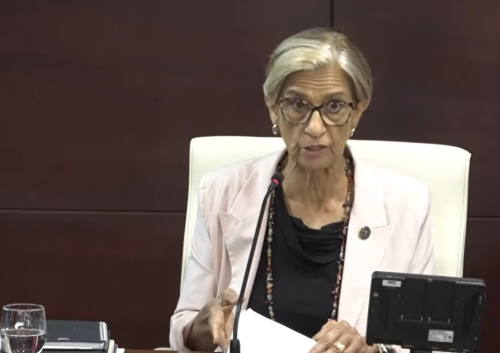 Chair Rejects Claims of Rights Violations
Chairlady Sarah Wescot-Williams spent considerable time responding to nearly every criticism.
She rejected claims that Members' rights were being infringed, insisting the proposal does not violate Parliament's Rules of Order.
She reminded Members that faction leaders' meetings are informal discussions and do not make binding parliamentary decisions.
Wescot-Williams also rejected suggestions that Parliament was attempting to fast-track the budget, stating that the problems surrounding the 2025 budget arose for entirely different reasons.
The Chair further argued that Members would not lose any rights because Government cannot proceed to a public budget debate until it formally answers Parliament's written questions.
If Government fails to respond, she explained, Parliament simply cannot continue consideration of the budget.
She also noted that the budget document already exceeds 300 pages and contains detailed ministry explanations available both to Members and to the public through Parliament's website.
Rather than requiring ministers to repeat information already contained in the document, she argued that Members should use the written process to identify the issues requiring further clarification before the public debate.
Wescot-Williams concluded by proposing that Parliament submit all questions by July 2, ratify them on July 6, give Government roughly two weeks to respond and then begin the public budget debate during Parliament's summer recess if all responses are received.
Political Battle Begins Before Budget Debate
Ironically, the first major battle over the 2026 Budget had nothing to do with government spending, tax policy, education, healthcare or infrastructure.
Instead, Parliament spent nearly an hour debating how the Budget should be debated.
The exchange exposed deep divisions between coalition and opposition MPs over transparency, accountability and parliamentary procedure.
With the 2026 Budget already months behind schedule, Friday's confrontation demonstrated that the political battle over the country's finances had begun well before Minister Marinka Gumbs presented the first page of Government's financial plan.