



~Before the Intervention- Public Health & the Right Question~
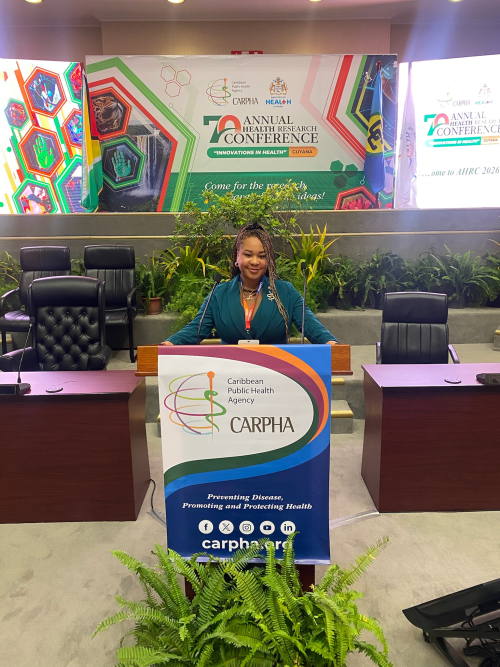 PHILIPSBURG:--- Khalisha Halley grew up in St. Maarten with a passion for women's health. Now she's presenting research at one of the Caribbean's biggest public health stages, and she's only getting started.
There is a special grace and grit that persons native to St. Maarten possess when building their future off island. Be it in academia, business, the public sector, or culture. It may not be loud, but it is noticed, it is felt, and undeniable. Through grueling nights of study, clinic rotations, and meticulous research and problem-solving, grace and grit build. Khalisha Halley has that special grace and grit.
The Florida A&M University doctoral student recently stood before an audience at the 70th Annual CARPHA Health Research Conference in Georgetown, Guyana, and presented findings from her master's thesis on substance use during pregnancy and its link to low birth weight. She was one researcher among many at a conference that drew ministers of health, heads of government, and global public health leaders from across the hemisphere and held her own.
Khalisha grew up with an early pull toward healthcare, specifically the kind that centers women. Maternal health, pregnancy, the postpartum window. From childhood, those areas held her attention in a way that other fields never quite did. That interest followed her through her undergraduate studies at FAMU, where she earned a bachelor's degree in Pre-Med Biology. Then came the gap year, working at a clinic, and the first real encounter with public health as a distinct field with its own methods, its own tools, and its own way of asking questions.
It was her Master of Public Health program that sharpened everything. She spent months rotating through the Florida Department of Health, volunteered with organizations doing public health work in different capacities, and landed her first job as a health analyst before finishing the degree. Those experiences changed how she thought about the work itself.
"When an adverse health outcome repeatedly appears in a population, it takes more than personal stories to truly understand its impact," she says. "Health outcomes should be recorded in a standardized and organized way so analysts can measure the actual burden of a disease or condition within a population. From there, you can identify associations, risk factors, trends, and insights that help guide evidence-based policies and interventions."
That conviction sent her back to school. She is now pursuing a Doctor of Public Health in Epidemiology and Biostatistics at FAMU, a degree that placed research at the center of her training and made conducting population-level studies feel not just possible but necessary.
Her thesis research, which formed the basis of her CARPHA presentation, examined whether marijuana use during pregnancy was associated with low birth weight, comparing it against exposure to other substances. The data came from real-world population health records, and the patterns she found added to a growing body of literature at a moment when public perception of marijuana is shifting fast, partly due to legalization spreading across different states and countries.
"A lot of people are surprised by how many women test positive for substances at birth," she says. "But what matters is understanding whether there is a measurable association with outcomes like low birth weight, and what the data actually shows."
She is careful not to let the research drift into judgment. She talks about social determinants of health the way someone talks about something they believe in, not just something they studied. Poverty, chronic stress, childhood trauma and limited access to healthcare. These, she argues, are what drive vulnerability to substance use during pregnancy, not personal failure. A meaningful public health response, she says, would be built around support rather than punishment, with routine screening during prenatal visits, community outreach, mental health resources, and better local data systems so that islands like St. Maarten can conduct their own studies and track their own trends.
Guyana was her first time presenting her research at a regional conference of this scale. The 70th CARPHA Health Research Conference brought together not just researchers but senior government officials from across the region. Ministers of Health from Guyana, Belize, Dominica, Grenada, and Trinidad and Tobago attended. The Prime Minister of St. Kitts and Nevis was there, as was the President of Guyana. The Executive Director of CARPHA, the Director of PAHO/WHO, the Deputy Director General of the European Union, and the CARICOM Secretary General all gave remarks. It was not a small gathering.
Outside of her own presentation, one session stood out. The chair of Global Women's Health presented an update on a program called SMARThealth. The program trains community health workers to conduct screenings that merge maternity care with noncommunicable disease prevention, identifying and helping to prevent long-term chronic conditions during and after pregnancy. It reduces barriers to access, improves early detection, and strengthens continuity of care for women in rural communities.
"I found it especially impactful because it connects maternal health with long-term disease prevention in a practical and community-based way," Khalisha says. For someone who has spent years thinking about what happens to women before, during, and after pregnancy, it was exactly the kind of model she wants to see more of.
Another conversation also stayed with her. During a panel discussion on leveraging innovation to reduce disease burden in the Caribbean, panelists raised the idea of regional specialization, certain islands becoming centers for specific medical services that neighboring islands could access and refer patients to, rather than every island independently trying to build capacity for every specialty. It struck her as both practical and forward-thinking.
She also connected with researchers from the Bahamas, Barbados, and Washington D.C., some of whom work closely with their ministries of health on research initiatives. Those relationships matter to her. She has tried to access public health data from entities in St. Maarten for research purposes and has not always succeeded. But the conference gave her something to hold onto.
"There are public health professionals on this island who understand the value of evidence-based policy," she says. "I believe that. I hope to contribute to that work one day."
For now, she is finishing her doctorate and building toward what comes next, with grace and grit.