




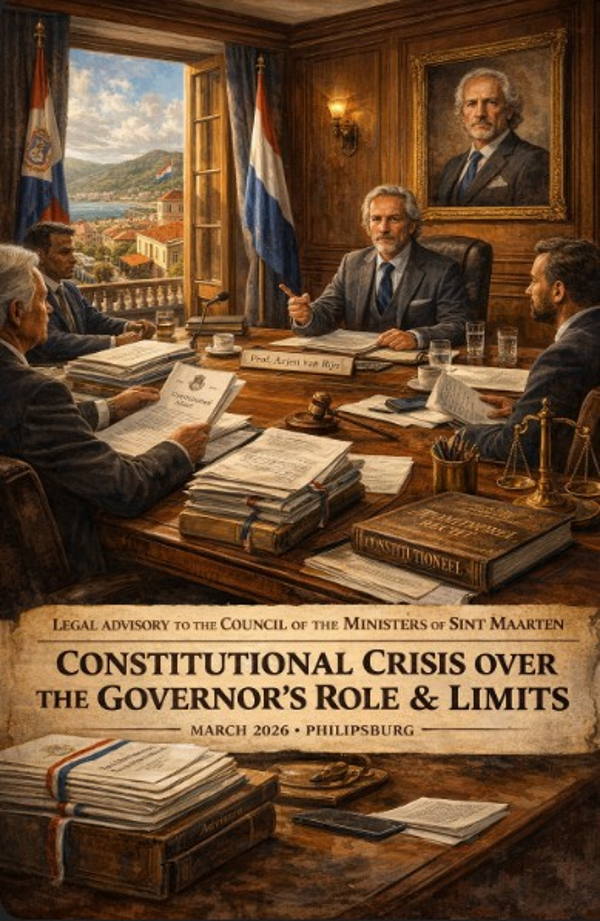
 PHILIPSBURG:--- In March 2026, a legal advisory prepared by Professor Arjen van Rijn was submitted to the Council of Ministers of Sint Maarten, addressing a critical constitutional issue: the role and limits of the Governor within the country’s governance system.
The advisory was prompted by a January 2026 incident involving administrative decision-making and subsequent actions that raised serious constitutional concerns. At its core, the document examines whether the Governor acted within his legal authority—or whether those actions risked undermining democratic governance.
Background: The Incident That Triggered the Advisory
The issue began with an incident on January 7, 2026, involving disciplinary action against a civil servant. The government imposed an immediate administrative measure, followed by a suspension decision that required formal approval by a national decree.
However, complications arose during the decision-making process:
- The Governor intervened in the Council of Ministers’ proceedings
- The Prime Minister and another minister were reportedly prevented from attending a meeting
- The Governor participated in deliberations with an advisory vote
- The Governor returned and delayed signing the decree, requesting further review
These actions led to confusion over authority and raised questions about whether constitutional boundaries had been crossed.
The Core Constitutional Question
The advisory focuses on a fundamental issue:
What are the legal limits of the Governor’s authority within Sint Maarten’s constitutional framework?
To answer this, the advisory examines the Governor’s dual role and the principle of ministerial responsibility.
The Dual Role of the Governor
The Governor of Sint Maarten operates in two distinct capacities:
1. Constitutional Head of Government (National Role)
In this role, the Governor:
- Represents the King within Sint Maarten
- Forms part of the government together with the ministers
- Acts formally as the head of the executive
However, crucially:
- The Governor has no independent governing authority
- All actions fall under ministerial responsibility
- Ministers—not the Governor—are politically accountable to Parliament
2. Representative of the Kingdom Government (Kingdom Role)
In this capacity, the Governor:
- Safeguards the interests of the Kingdom of the Netherlands
- Ensures compliance with Kingdom law
- May intervene if national decisions conflict with Kingdom interests
This role includes a key power:
- The ability to refuse to sign a decree and escalate it to the Kingdom government
A Fundamental Principle: No Independent Power
A central conclusion of the advisory is:
The Governor does not possess independent decision-making authority within the national government.
Instead, the Governor’s role is limited to:
- Being consulted
- Offering advice
- Providing warnings
- Encouraging reconsideration
But ultimately:
The ministers decide—and the Governor must follow.
This principle is rooted in parliamentary democracy: elected officials must hold power, not appointed representatives.
“No Third Way”: A Critical Doctrine
One of the most important legal conclusions in the advisory is the rejection of a so-called “third role” for the Governor.
The Governor can act only as:
- Head of government (without independent power), OR
- Kingdom representative (with escalation powers)
There is no middle ground where the Governor acts as an independent constitutional guardian with autonomous authority.
Allowing such a “third way” would:
- Undermine democratic accountability
- Blur lines of responsibility
- Concentrate unelected power in a non-political office
Historical Context: The Van der Meer Affair
The advisory draws on precedent, particularly the Van der Meer affair, which clarified that:
- The Governor may form opinions and engage in discussion
- But in case of disagreement, ministers have the final say
- The Governor must ultimately “sign at the dotted line”
This historical case reinforces the doctrine that the Governor’s authority is subordinate in national governance matters.
Assessment of the Governor’s Actions in the 2026 Case
The advisory concludes that the Governor exceeded his authority in several ways:
1. Interfering with Ministerial Participation
The Governor informed certain ministers that they could not attend a Council meeting.
- This is problematic because:
- The Council of Ministers determines its own functioning
- The Governor has no authority to exclude ministers
2. Participating Actively in Cabinet Deliberations
The Governor attended and engaged in discussions with an advisory vote.
- This is considered inappropriate because:
- The Governor should remain above political decision-making
- Active participation risks politicizing the office
3. Influencing Policy Direction
Decisions taken in meetings suggested a shift in policy direction influenced by the Governor.
- This undermines:
- The political primacy of elected officials
- The authority of the Prime Minister
Democratic Risks Identified
The advisory warns that such actions pose serious risks:
- Erosion of ministerial responsibility
- Weakening of democratic legitimacy
- Blurring of constitutional roles
- Potential constitutional crisis
A key insight:
The Governor is not democratically accountable, while ministers are. Therefore, the Governor must not take on a political role.
The Proper Use of Governor’s Powers
The advisory clarifies what the Governor should do in contentious situations:
- Advise and warn ministers
- Respect ministerial decision-making
- If necessary, refuse to sign a decree
- Immediately refer the matter to the Kingdom government
This ensures:
- Legal oversight without undermining democracy
- Clear accountability structures
Resolution of the Case
Eventually, after legal developments:
- A revised decree was submitted
- The Governor signed it
- The proper constitutional procedure was restored
This outcome aligned with the correct legal framework.
Final Conclusions of the Advisory
The advisory reaches a strong and unequivocal conclusion:
- The Governor’s actions exceeded constitutional limits
- They undermined the authority of the Prime Minister and the Council of Ministers
- They were constitutionally and democratically unacceptable
Recommendations
The advisory urges the government to:
- Clearly reaffirm constitutional boundaries
- Engage in dialogue with the Governor
- Prevent recurrence of similar situations
- Protect the primacy of democratic governance
It also warns against allowing precedents that could gradually expand the Governor’s role beyond its legal limits.
Conclusion
This advisory highlights a fundamental tension in constitutional systems that combine local autonomy with Kingdom oversight. While the Governor plays an essential role in safeguarding legal order, that role must remain strictly limited.
The key takeaway is clear:
Democratic authority must remain with elected officials.
The Governor advises, safeguards, and escalates—but does not govern.
Click here to read Professor Van Rijn's advice to Prime Minister Dr. Luc Mercelina.