




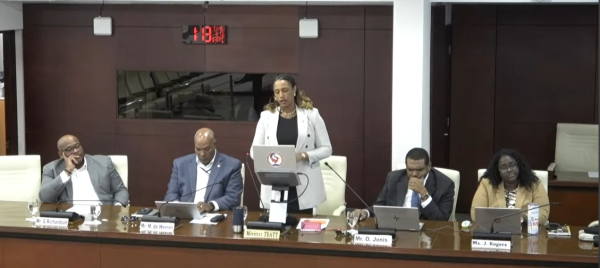
 PHILIPSBURG:--- The Ministry of Tourism, Economic Affairs, Transport, and Telecommunication (TEATT) sits at the center of a growing financial controversy. Minister Grisha Heyliger-Marten faces intense scrutiny regarding her handling of the Soul Beach Music Festival and the highly contested Social Economic Council (SER) report used to justify its costs.
Responding to criticism, Minister Heyliger-Marten defended her ministry’s actions: “The Soul Beach Music Festival was a calculated investment intended to boost our island’s economy and tourism,” she stated in parliament on Wednesday. “All actions taken were in the best interest of the people of St. Maarten and designed to bring tangible benefits to our community.”
On the SER report’s methodology, she further clarified, “While the report relied on data from the festival organizers, we believed it offered a realistic projection of the event’s potential. The economic impact of such activities must not be underestimated, and our goal was to provide Parliament and the public with as much information as possible.”
Minister Heyliger-Marten acknowledged the concerns about transparency and process, adding, “I am committed to working closely with Parliament to address these procedural questions, and I welcome any audit or additional oversight. Transparency is a cornerstone of this Ministry, and I stand by our intent to act with integrity and accountability.”
At the heart of the dispute is a $500,000 commitment to public funds. The government disbursed this massive subsidy without proper budgetary allocation or prior parliamentary approval. While we all want to see vibrant economic activity and booming tourism on the island, bypassing established financial laws has drawn fierce backlash from lawmakers and the public alike.
A Disputed Economic Impact
To defend the half-million-dollar expenditure, Minister Heyliger-Marten and the government presented an SER report. She asserted, “We believe the Soul Beach Music Festival generated substantial value for St. Maarten, with the SER report indicating an upper bound estimate of $7.2 million in economic impact.” Addressing concerns about the figures, she added, “Our intention was to provide a comprehensive overview of potential benefits. Events like Soul Beach can be transformative for the local economy—not just in direct revenue but in long-term visibility and job creation.” However, the methodology behind this report quickly collapsed under parliamentary review.
Critics pointed out a glaring conflict of interest: the report relied entirely on attendance figures and financial data provided by the festival organizers themselves. The Ministry of TEATT did not conduct an independent audit, nor did they hire a third party to verify the visitor numbers. Presenting organizer-supplied data as an impartial analysis has fueled accusations of administrative manipulation and lack of transparency.
Financial Mismanagement Claims
The controversy places heavy pressure on Minister Heyliger-Marten's leadership. Addressing concerns about the legal process, she remarked, “I acknowledge the need to follow legal and budgetary procedures closely. The decision to allocate funds for Soul Beach was made with the view that it would yield both immediate and long-term benefits for St. Maarten.” She continued, “We are committed to upholding fiscal responsibility, and if there were oversights, I welcome any constructive feedback and investigation. It was never the intention to circumvent protocol, but to act decisively in the best interest of our people.” Parliamentarians, however, argue that releasing $500,000 without a formal budget amendment represents a severe breach of financial protocol.
The SER report itself noted irregular financial practices and a failure to adhere to the standard subsidy ordinance. This raises immediate questions for the Minister. Did the organizers submit the required financial and activity reports as mandated by law? Why did the Ministry fail to bring a budget amendment to Parliament before signing the checks?
Lawmakers contrast this rapid, unauthorized payout with the struggles of other government sectors, noting that essential services often fight for basic funding while this festival received immediate financial backing.
Demanding Accountability
The debate over the Soul Beach Music Festival highlights a broader issue of governance and public trust. The continuous disregard for budgetary rules damages the credibility of the TEATT Ministry. In response to increasing calls for transparency, Minister Heyliger-Marten said, “I understand and respect Parliament’s right to demand full disclosure and scrutiny of every step taken. I have no objection to making all relevant documents available and remain open to ongoing dialogue with lawmakers and the public.” Reiterating her stance on public accountability, she added, “Our community deserves straightforward answers, and I am fully committed to ensuring that the process remains transparent from start to finish.”
Parliament now demands that Minister Heyliger-Marten provide full transparency. Lawmakers are calling for the immediate submission of all documents, including original agreements, financial reports, post-event evaluations, and all correspondence related to the festival subsidy.
As the pressure mounts, the public watches closely. We need a government that balances aggressive tourism development with strict fiscal responsibility. Minister Heyliger-Marten must now answer these critical questions and prove that her Ministry can manage public funds with the integrity the people of St. Maarten expect.