~ Company admits unidentified payments, disputed accounts, dead-account holders, and billing complications continue to haunt operations.~
 PHILIPSBURG:--- More than four years after the cyberattack that crippled NV GEBE's billing and customer management systems, the utility is still struggling to determine where some customer payments belong, exposing a web of unresolved account disputes, landlord conflicts, incomplete customer records and administrative challenges that continue to affect thousands of customers.
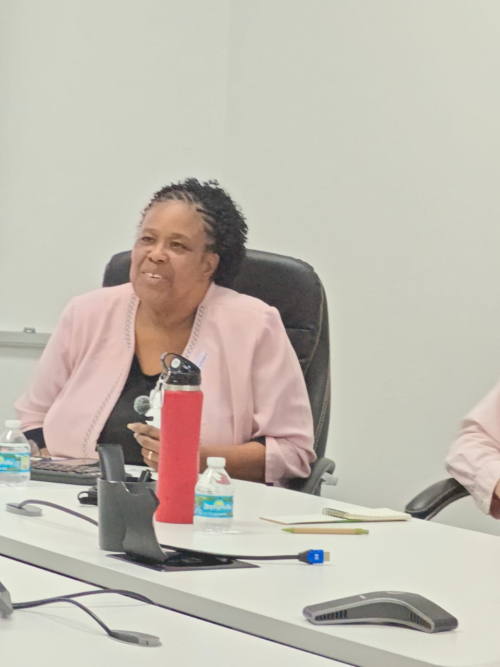
During Friday's press conference, Temporary Manager Iris Arrindell revealed that despite years of reconstruction efforts following the March 17, 2022, cyberattack, GEBE continues to receive payments that cannot be matched to customer accounts.
"To date, we still have monies that we have received, and we do not know where to apply some of those funds," Arrindell admitted.
The statement was one of the most striking revelations during Friday's briefing and offers a glimpse into the lingering impact of the cyberattack that erased critical customer and billing data from the utility's systems.
March 17, 2022: The Day Everything Changed
According to the presentation slides shown during the press conference, GEBE's systems were compromised on March 17, 2022. Management quickly discovered that not only had the company's systems been breached, but internal backups had also been compromised.
The presentation states that only certain information stored on desktop computers survived the attack.
Two days later, management assessed what remained.
The results were alarming.
The only available digital backup dates back to March 2021. The utility's customer open balances as of February 2022 survived only because they had been downloaded to a desktop computer on March 9, 2022. The company also had access to paper meter reading schedules, meter readings, bank statements, and manually generated work orders.
Faced with the possibility of having to rebuild an entire year of operational history, management rejected suggestions to create estimated bills in Excel and instead hired SAP consultants to reconstruct the company's database using both digital and paper records.
Customers were instructed to continue paying their normal bills while reconstruction efforts were underway.
Rebuilding a year of lost history
Consultants hired by GEBE concluded that information created between March 2021 and March 17, 2022, had effectively been lost.
The company was forced to reconstruct customer accounts using open items, historical records, and manually created orders before uploading the information back into SAP.
As part of the recovery process, GEBE created what became known as "bridge bills" to maintain continuity between the old and reconstructed systems.
However, the process did not go smoothly.
Management disclosed that January meter readings were mistakenly used in place of February readings during part of the reconstruction effort, necessitating corrections to March 2022 bills across the customer base. Additionally, bridge bills that were never intended for customer distribution were inadvertently sent out, creating confusion and public concern.
The utility spent months correcting records and rebuilding customer histories.
The Account Number Problem
One of the most persistent issues facing GEBE today involves customer payments that cannot be matched to specific accounts.
According to Arrindell, many customers paid their bills through the banking system without including their contract account numbers.
As a result, funds were received by GEBE but could not always be linked to the correct customer account.
The utility repeatedly asked customers to visit its offices with proof of payment so transactions could be verified and applied correctly.
Years later, some of those payments remain unresolved.
"We do not know where to apply some of those funds," Arrindell said.
The result is that money may have been paid, but the utility cannot always determine which customer should receive credit.
Landlords, Tenants, and Unpaid Bills
Presentation slides also revealed one of the utility's most frustrating challenges: rental properties.
According to GEBE, many landlords keep utility accounts in their own names while collecting utility payments from tenants as part of rental agreements. Problems arise when those funds are not forwarded to GEBE.
When disconnections occur, tenants often insist they have already paid.
"The tenant says, 'I paid the landlord,'" Arrindell explained during the press conference.
However, from GEBE's perspective, the account holder remains legally responsible for the debt.
The utility says these situations continue to create disputes and complicate collection efforts.
Dead Account Holders, Live Services.
The utility also disclosed that inheritance issues remain a major obstacle to maintaining accurate customer records.
According to GEBE's presentation, many accounts remain registered in the names of deceased persons because families never formally transfer ownership after a death.
Management explained that utility accounts often become entangled in inheritance disputes involving multiple heirs.
As a result, electricity and water services continue to be supplied under the names of people who are no longer alive.
GEBE says it often has no way of knowing an account holder has died unless family members voluntarily come forward.
People Move, Accounts Stay Behind
Another issue highlighted by management is the high level of residential movement on St. Maarten.
According to Arrindell, approximately 200 people move to and from the island each month.
Customers frequently move out without notifying GEBE, while new occupants move into properties and begin using utilities connected to accounts that remain in someone else's name.
When collections begin or disconnections occur, the utility often finds itself trying to determine who actually incurred the debt.
The problem became even more difficult after the cyberattack forced the company to reconstruct years of customer movement records.
More than half of customers are still out of Reach
One of the more surprising disclosures from the presentation was that more than half of GEBE's customers have still not provided updated contact information.
The utility has repeatedly asked customers to submit email addresses and telephone numbers so notices, reminders, and billing information can be delivered electronically.
According to management, the lack of updated contact information continues to hinder communication efforts and contributes to disputes over billing and collections.
How GEBE changed its Policies
The presentation also showed how the utility altered its collection and customer assistance policies in response to the crisis.
Initially, GEBE focused disconnections primarily on businesses while attempting to sort out customer account issues.
The company also made a significant concession to customers by absorbing the cost of all water leaks prior to December 2024. Management said delayed billing during 2023 and 2024 prevented many customers from identifying excessive water usage in time to correct problems.
Payment plans were expanded beyond water-leak cases and offered to customers struggling with balances from the post-hack period.
However, management found that many customers paid only the payment plan amount while allowing current bills to continue accumulating. The company has since revised its approach and now requires customers to make payments that address both outstanding balances and current consumption.
Customers unable to cover even their current monthly bills are referred to Social Services for possible assistance.
According to Arrindell, that collaboration eventually evolved into a formal support program between GEBE and Social Services.
The Hidden Side of the Collection Crisis
The billing complications help explain why GEBE continues to struggle with collections.
Management disclosed that only 58.6 percent of customers paid their bills in May 2026, while more than 9,500 customers remain delinquent.
Public attention has largely focused on disconnections, rising utility costs, and fuel clauses.
But Friday's presentation revealed another reality: collecting money is only part of the problem.
Identifying who owes what, who has already paid, and where certain payments belong remains an ongoing challenge.
GEBE'S own analogy tells the story
Perhaps the most revealing slide presented by Arrindell compared GEBE to an employee earning XCG 26,386 per month but receiving only 58.6 percent of that salary because customers are not paying.
According to the presentation, the utility effectively receives XCG 15,462 while still incurring obligations totaling XCG 14,199 for fuel and water purchases, XCG 4,000 for operating expenses, and XCG 750 for general expenses. The resulting shortfall must be covered through cash flow reserves.
The message was clear: GEBE is not simply dealing with a collections problem. It is still grappling with the consequences of a cyberattack that fundamentally disrupted customer records, payment histories, and account management.
Four years after March 17, 2022, the systems may be back online, but the utility's own presentation makes clear that the effects of the hack continue to ripple through every aspect of its operations.
And perhaps the most troubling revelation of all is that some of the money is still sitting in GEBE's accounts with no one knowing exactly where it belongs.
 PHILIPSBURG:--- On Saturday afternoon, June 20, 2026, the Police Force of Sint Maarten (KPSM) received credible information indicating that several individuals residing at a hotel in the Oyster Pond area were unlawfully in possession of firearms. Acting swiftly on this intelligence, the KPSM immediately deployed a combined unit of detectives and patrol officers to the location.
 PHILIPSBURG:--- In response to a recent increase in serious scooter and vehicle accidents, as well as firearm-related incidents on both sides of the island, the Police Force of Sint Maarten (KPSM) conducted a traffic control over the weekend of June 20, 2026, on the A.J.C. Brouwers Road.
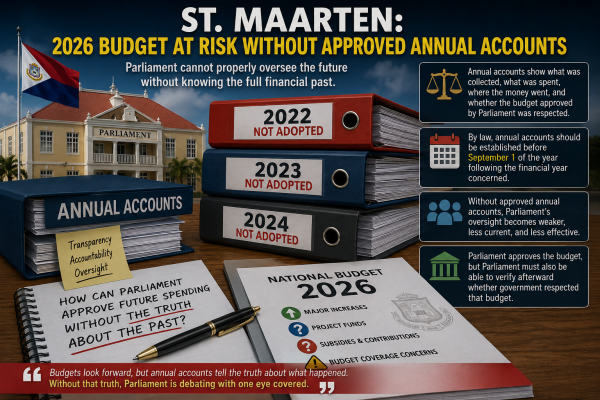 PHILIPSBURG:--- As Parliament prepares to handle the 2026 budget, possibly starting June 26, another serious issue is emerging from the budget documents and the Council of Advice's advice: St. Maarten is once again preparing and debating a national budget without the most recently approved annual accounts.
 A recent opinion issued by France’s Judicial Ethics College has reignited debate over the relationship between Freemasonry and the judiciary, concluding that membership in a Masonic lodge may be incompatible with the ethical obligations expected of judges and magistrates.