 PHILIPSBURG:--- SXM Doet is pleased to announce the generous contribution of twenty (20) gas vouchers from SOL Antilles N.V in support of the 2026 edition of SXM Doet.
The fuel vouchers will be used to assist SXM Doet’s volunteer coaches, who play an essential role in ensuring the smooth coordination and support of projects taking place across the island during the two Doet days. Volunteer coaches are responsible for traveling to various project locations, offering guidance, checking in on participating organizations, and helping maintain the momentum and spirit of volunteerism throughout the event.
This contribution helps ease some of the transportation-related costs experienced by volunteer coaches and serves as a meaningful gesture of appreciation for their dedication and commitment to community service.
The SXM Doet team would like to extend our heartfelt gratitude to Mr. Robert James and the entire SOL Antilles team for their continued support and partnership.
“We are truly thankful to SOL Antilles for once again coming on board to support SXM Doet. Contributions such as these go a long way in helping us support the individuals who work tirelessly behind the scenes to ensure the success of the event,” the project coordinators shared.
This marks the second consecutive year that SOL Antilles has contributed fuel vouchers to SXM Doet, further demonstrating the company’s commitment to community engagement and volunteerism on Sint Maarten.
SXM Doet 2026 takes place on May 15th and 16th and will bring together a thousand plus volunteers and community organizations for the largest volunteer initiative in the Dutch Kingdom. Persons interested in volunteering are encouraged to sign up and learn more via www.sxmdoet.com or email us at This email address is being protected from spambots. You need JavaScript enabled to view it..
KPSM Arrests Suspect in Cross-Border Drug Investigation.
 PHILIPSBURG:--- The Police Force of Sint Maarten (KPSM) announces the arrest of a suspect in connection with an ongoing investigation into drug trafficking activities.
On Tuesday, May 19, 2026, the suspect identified by the initials B.A.E., age 33, was arrested on suspicion of organizing the export of hard drugs to surrounding countries. The suspect has since been questioned and remains in custody pending further investigation.
This investigation is being conducted by KPSM’s Pelican Team, a specialized unit responsible for carrying out cross-border investigations related to drug trafficking and firearm-related offenses.
KPSM, together with its external law enforcement partners, remains committed to investigating and combating organized cross-border criminal activities that threaten the safety and security of the community and the wider region.
KPSM is requesting anyone with information regarding this case, or any similar criminal activity, to contact the Police Station at +1 (721) 542-2222 or call the anonymous tip line at 930
Why is Parliament’s Justice Committee doing nothing with the Criminal Procedure Reform?
 PHILIPSBURG:--- St. Maarten cannot afford to treat justice reform as a side issue. Questions about arrests, investigations, court cases, victims’ rights, due process, police powers, prosecution standards, and public confidence in the justice system are not abstract matters. They affect people’s liberty, safety, rights, and trust in the rule of law.
That is why the functioning — or lack thereof — of Parliament’s Justice Committee deserves serious public attention.
Parliament is not merely an observer in the legislative process. It is a co-legislator. Its committees are supposed to examine serious national issues, question ministers, study draft legislation, and help advance important reforms. When the country faces repeated concerns within the justice system, the Justice Committee should be among the most active committees in Parliament.
Instead, on one of the most important justice reforms before the country — the modernization of the Criminal Procedure Code — the committee has been almost invisible.
This is not a new issue. The previous Parliament, from 2020 to 2024, did significant work on this file. Importantly, Parliament did not simply sit down and draft a new Criminal Procedure Code on its own. A tender was issued. That tender was won by the law firm of Peggy Ann Brandon, which was hired to conduct an independent legal review and drafting process.
That Law Firm drafted the proposed new Criminal Procedure Code, including its explanatory notes, while working in discussion with the Justice Committee of Parliament during the 2020–2024 parliamentary term. The purpose was not political convenience. It was not to create legislation that could be accused of favoring any person, party, prosecutor, defendant, or government.
The guiding principle was clear: bring St. Maarten’s criminal procedure in line with modern standards in the Netherlands, the Kingdom, and Europe.
That point matters. Criminal procedure governs how the state investigates, prosecutes, arrests, detains, questions, tries, and punishes people. It also affects victims, police officers, prosecutors, judges, attorneys, and the wider public. If the rules are outdated or unclear, everyone in the justice chain suffers.
The previous committee understood that St. Maarten was lagging behind. It also understood that any reform had to be balanced. The new code had to protect the rights of suspects and defendants while also providing the prosecution and law enforcement with a clear, modern framework. It had to strengthen due process, clarify procedures, and bring the country closer to the standards already in place elsewhere in the Kingdom and Europe.
From what is publicly known, the committee completed and approved the draft for handling up to the 2024 parliamentary year.
Then a new Parliament came in — and the file appears to have gone quiet.
For the first part of this Parliament, the Justice Committee was chaired by MP Sjamira Roseburg. For the second part, the chairmanship moved to MP Franklin Meyers. Yet under both chairmanships, the public has seen no serious movement on the draft Criminal Procedure Code.
The committee has not visibly discussed the draft. It has not publicly questioned the Minister of Justice on its implementation. It has not explained whether the draft is still being reviewed, amended, delayed, rejected, or ignored. It has not informed the public what obstacles remain, what timeline exists, or whether the justice chain has been consulted on the next steps.
That silence is difficult to justify.
In recent times, St. Maarten has seen growing public concern about criminal cases, arrests, court decisions, prosecutorial choices, police actions, and broader questions about fairness and consistency in the justice system. Not every controversy would be solved by a new Criminal Procedure Code. But many of the recurring issues would at least be addressed within a clearer and more modern legal framework.
That is exactly why this draft matters.
If the Justice Committee is meeting on prison conditions, police concerns, youth crime, and other justice-related matters, then it cannot avoid the central legislation that governs criminal procedure itself. Those topics are important, but they all connect to the same foundation: the laws under which the justice system operates.
So the question must be asked directly.
Why did MP Sjamira Roseburg, as former chair of the Justice Committee, not move this draft forward in a visible and urgent way?
And why has MP Franklin Meyers, as the current chair, not placed the draft Criminal Procedure Code at the top of the committee’s agenda?
The committee should immediately call the Minister of Justice to provide a full status update. It should ask whether the draft prepared by the law firm of Peggy Ann Brandon is still the working document. It should ask whether the government supports it, whether changes are being proposed, whether advice has been requested, and when Parliament can expect formal handling.
The committee should also make clear whether consultations have taken place with the courts, the Public Prosecutor’s Office, the Bar Association, police leadership, victim-support organizations, prison authorities, and other relevant justice stakeholders.
These are not extraordinary requests. They are basic oversight.
St. Maarten’s justice system cannot continue operating with major reforms sitting in drawers while Parliament moves from one committee chair to another without explanation. The country paid for legal expertise. A law firm was selected through a tender. A draft was prepared with explanatory notes. The previous committee worked on it. The justice chain has long recognized the need for modernization.
Now the current Justice Committee must explain what it is doing with that work.
Justice reform should not depend on personalities, political convenience, or whether a committee chair chooses to make it a priority. It is a national obligation.
If Parliament is serious about strengthening the rule of law, the Justice Committee must stop treating the Criminal Procedure Code as a forgotten file. It must put the draft on the agenda, question the minister, inform the public, and set a clear path toward debate and implementation.
Anything less is not oversight.
It is neglect.
TEATT Minister defends cannabis legalization process, says current government inherited framework.
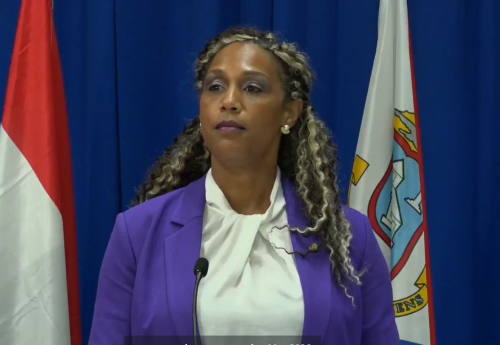 PHILIPSBURG:--- Minister of Tourism, Economic Affairs, Transport and Telecommunication (TEATT) Grisha Heyliger-Marten defended the government’s ongoing cannabis legalization initiative on Wednesday, stating that the current administration inherited the framework and contractual obligations from a process initiated under the previous government in 2022.
The issue arose during the question-and-answer segment of Wednesday’s Council of Ministers press briefing, where the minister was asked about concerns surrounding the company involved in both drafting the cannabis legislation and potentially participating commercially in the future cannabis industry.
Responding to the questions, Heyliger-Marten clarified that the process did not originate under her administration.
“The process did not originate with me during my tenure,” the minister said. “It started in 2022 when the former government issued a bid specifically seeking a partner that could both assist with developing the legal and operational cannabis framework and potentially remain involved in the industry afterward.”
According to the minister, the original request for proposals (RFP) invited bidders to outline not only how they would assist with legislation and operational planning, but also their potential future investment and involvement in the cannabis sector.
The company Native Nations was ultimately selected under that process before the current administration assumed office.
“My administration inherited a project under that contract, and we continue to meet those obligations based on that contract,” Heyliger-Marten explained.
The minister acknowledged public concerns about potential conflicts of interest but stressed that the current government’s role has been primarily to continue and refine an existing agreement.
She added that her administration, alongside the Ministries of Justice, Finance, and VSA, negotiated additional benefits for the country as part of the ongoing framework discussions.
Those additions reportedly include a proposed US $750,000 contribution toward a local non-profit organization as well as the incorporation of agricultural development initiatives aimed at supporting local farmers and food production alongside the cannabis sector.
“We were able to negotiate additional benefits for the country,” the minister stated.
When asked what the government’s primary interest was in pursuing cannabis legalization, Heyliger-Marten indicated that the initiative serves both economic and judicial purposes.
“Based on what is there, based on what we received, it’s both for judicial and economic reasons,” she said.
The minister did not provide a timeline for when legislation could formally reach Parliament but indicated that government continues working within the framework established under the previous administration while seeking to maximize benefits and safeguards for St. Maarten.
The discussion surrounding cannabis legalization has generated increasing public debate in recent months as government continues examining regulatory, economic, agricultural, and law enforcement implications tied to a potential legal cannabis industry on St. Maarten.
TEATT Minister Activates GEBE Oversight, Pursues Fuel Relief and Tariff Transparency.
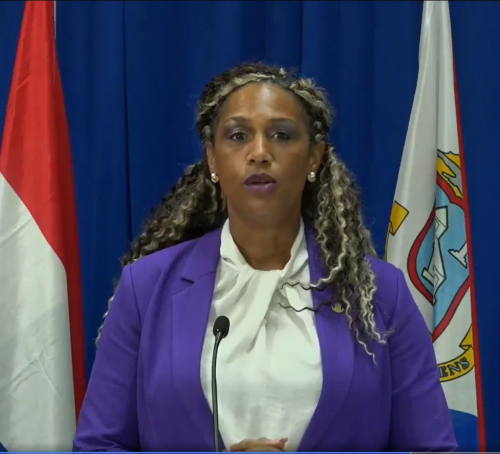 PHILIPSBURG:--- Minister of Tourism, Economic Affairs, Transport and Telecommunication (TEATT) Grisha Heyliger-Marten announced Wednesday that the government has formally activated legal oversight mechanisms over NV GEBE amid mounting public concerns over electricity costs and fuel clause increases.
Speaking during the Council of Ministers press briefing, Heyliger-Marten detailed the government’s ongoing efforts involving GEBE, the Bureau Telecommunication and Post (BTP), and the electricity tariff regulation.
BTP Officially Designated as Supervisor
According to the minister, the government has now formally designated the Bureau of Telecommunication and Post as the legal supervisory authority under the Electricity Concession Ordinance.
The designation was approved through a ministerial decree signed jointly by the TEATT and VROMI ministries and is currently awaiting publication.
“For the first time, an independent authority will have the legal power to verify GEBE’s numbers, test its assumptions, and hold the company accountable under the law,” Heyliger-Marten stated.
Under Articles 20 and 21 of the ordinance, BTP will now have authority to demand information, conduct inspections, audit operational and financial data, review tariff calculations, assess fuel clause methodologies, and enforce compliance measures.
Government Says GEBE Failed to Provide Key Data
The minister explained that the government initially mandated BTP in January 2025 to conduct an independent review of GEBE’s tariffs with support from the Curaçao regulator RAC.
However, the April 2025 report reportedly identified significant gaps in GEBE’s data, tariff methodology, maintenance planning, and cost transparency.
Heyliger-Marten stated that the fuel clause formula could not be independently validated due to insufficient cooperation from GEBE.
“The requested tariff proposal was not submitted,” she said, adding that GEBE has yet to provide the complete pricing structure requested by the government.
Fuel Clause and Tariff Concerns
Responding to public frustration over rising electricity bills, the minister stressed that the government cannot simply impose new tariffs without legally verified financial data.
“Government cannot invent a tariff, and government cannot guess a tariff,” she stated.
The Electricity Concession Ordinance requires tariffs to remain cost-oriented and based on verified operational expenses and investments.
The minister also warned that improperly setting tariffs could either overcharge consumers or destabilize the country’s only electricity provider.
Enforcement and Legal Consequences
Heyliger-Marten noted that under Article 29 of the ordinance, obstructing the supervisory authority or violating concession terms may result in fines or imprisonment.
“These are real consequences, and they will be enforced if necessary,” she said.
Renewable Energy Compliance
The minister further pointed out that Article 14 of the concession requires GEBE to increase renewable energy production, something the government says has not been adequately addressed.
“With BTP formally designated as supervisor, renewable energy compliance will no longer be optional,” she said.
Government Examining Fuel Relief Measures
On fuel prices generally, the minister confirmed that the government is examining temporary fuel relief measures while also working on a long-term framework to manage future fuel price spikes.
According to Heyliger-Marten, the government is evaluating whether increased turnover tax revenues generated through higher fuel prices can be partially redirected toward temporary excise tax reductions.
“We are pursuing relief in a lawful and financially responsible manner,” she stated.
The minister stressed that, unlike previous governments, the current administration intends to ensure all relief measures comply fully with legal procedures and standards of good governance.