Impact Quest Registration Extended to February 22th.

PHILIPSBURG:--- With strong community interest and teams continuing to sign up, organizers of the Impact Quest Scavenger Hunt have officially extended the registration deadline to February 22, 2026. The event will take place on Saturday, February 28, 2026, at the SXM Padel Club (PDP Court), as part of Sint Maarten’s kickoff celebration of the United Nations-declared International Year of Volunteers 2026.

The extension offers one final opportunity for teams to register for what is shaping up to be one of the island’s most dynamic volunteer-driven events of the year. Organized by Volunteer.sx in partnership with the St. Maarten Development Fund (SMDF), Foresee Foundation (4C), and the SXM Padel Club, Impact Quest invites the entire community to join in a day of connection, creativity, and collective impact, while placing a special focus on empowering youth through volunteerism. Teams of four to five participants will complete mini-missions inspired by real acts of service across St. Maarten, blending teamwork, creativity, and community impact.

This is not your average scavenger hunt. Teams will use a dedicated event app to access their missions, upload photos of completed challenges, answer impact-based questions, and earn points directly on a digital, interactive platform. The app adds strategy, accountability, and a competitive edge to every task while keeping the experience organized and engaging. To ensure full participation, teams will receive day-specific data so they can stay connected, access the app seamlessly, and focus entirely on completing their missions and making an impact.

Thanks to the generous support of event sponsors, youth teams can participate free of charge.
A limited number of teams with at least two participants under 25 also qualify for full sponsorship coverage. This ensures that financial barriers do not prevent young people from engaging in volunteerism and nation-building. Spots are limited and will be confirmed on a first-come, first-served basis.
The standard team registration fee remains USD 250, which supports event logistics, materials, safety coordination, and overall execution.

Impact Quest is more than a race for points and prizes. It is a platform for youth leadership, civic pride, and collective action. Teams will engage directly with local NGOs and community initiatives through creative and hands-on service challenges, demonstrating that volunteerism can be both meaningful and energizing.
The event will conclude with a celebratory Social Mixer at SXM Padel Club’s Port de Plaisance location, featuring music, games, prizes, and recognition of top-performing teams.

Registration closes February 22, 2026. Teams are encouraged to secure their spot immediately, especially those seeking sponsored youth participation. Register now at: bit.ly/impactquest

As Sint Maarten embraces the International Year of Volunteers, Impact Quest sets the tone for a year centered on collaboration, community engagement, and youth-driven impact. Youth engagement is not charity. It is nation-building in action.
To register or learn more, visit Volunteer.sx, sign up directly at bit.ly/impactques, or contact This email address is being protected from spambots. You need JavaScript enabled to view it.


Ombudsman of Aruba elected as Regional Director Caribbean and Latin America for the IOI.

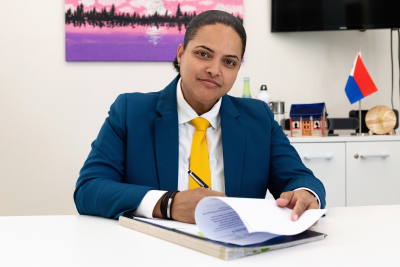
ombudsmanaruba18022026ORANJESTAD, ARUBA:--- Oranjestad, Aruba – The Ombudsman of Aruba, Ms. Jurima Bryson, LL.M., has been elected Regional Director for the Caribbean & Latin American Region of the International Ombudsman Institute (IOI).

In June 2025, the Office of the Ombudsman announced that the Ombudsman of Aruba was admitted as a member of the IOI after extensive screening. The IOI is an international organization. It brings together more than 200 Ombudsman institutes from more than 100 countries. Its goal is to support cooperation, good governance, transparency, and the protection of human rights.

As Regional Director, Ms. Bryson represents the Caribbean and Latin American region within the IOI. In this capacity, she promotes and facilitates the exchange of knowledge among member countries.

Her election reflects the international recognition of the work of the Ombudsman of Aruba and further strengthens Aruba’s position within the global network of Ombudsman institutions.

Ms. Bryson expressed her sincere appreciation for this unique opportunity: “I am deeply honored to receive this positive news, not only personally but also on behalf of my country, Aruba. With the support of my team, we have built an impartial, independent, and professional institute on our small island. It is truly encouraging to see that, even in its early stages, our work has already attracted international recognition. This development gives Aruba access to a broader network and affirms the international standing of our Ombudsman Institute. Just as I serve with dedication in my role as Defensor di Pueblo, Defender of the People, I will carry out my new role as Regional Director for the Caribbean and Latin America with the same commitment, dedication, and sense of responsibility.”


Francio Guadeloupe officially accepts chair of Kingdom Relations with inaugural lecture on March 12.

franciscoguadeloupe18022026The Netherlands:--- Professor Francio Guadeloupe, endowed professor of Public Anthropology of Kingdom Relations, will deliver his inaugural lecture at the University of Amsterdam on Thursday, March 12, 2026. He will deliver this inaugural lecture to accept the Chair of the same name, funded by the Ministry of the Interior and Kingdom Relations (BZK). Guadeloupe, born in Aruba, works for the Royal Netherlands Institute of Southeast Asian and Caribbean Studies (KITLV) and the University of Amsterdam. His research focuses on how people in different parts of the Kingdom shape their lives, often moving around, and what this means for their identity.
Research
During his inaugural lecture, titled "Reweaving Dutch Caribbean Studies," Guadeloupe delves deeper into the various components of his research. He introduces people he's spoken with and asks them about their identities. For example, a European Dutch woman he meets on a plane from Amsterdam to Bonaire. Or an Aruban woman who has re-emigrated to Aruba and now works in the tourism sector, where she comes into contact with Venezuelan staff. He is critical of how these Latin American workers are perceived and treated, and of the all-consuming tourism industry and its impact on the various islands.
Inequality
As an anthropologist, Guadeloupe focuses on four areas of research, all related to how people live together, connect with one another, and engage with different continents. Like a loom from which new fabric is constantly emerging: “Dismantling and reweaving the Kingdom is a contribution to reforming our far too unequal society.” This is how he concludes his inaugural lecture. Over the next four years, his research will focus on this and will be conducted from both the Netherlands and the Caribbean islands.
Film
As part of the Chair, Guadeloupe recently produced an anthropological film entitled "Changá" ("Double Game"), which premiered last January in Aruba and Curaçao. The film takes the viewer along a rhythm of the philosophy of dominoes: how do people respond to what life hands them? Here, too, the theme of identity is prominent. “Through Changá, we discuss the sense of belonging of Dutch Caribbean citizens in the Netherlands, so to what extent the Netherlands is (also) their home,” says Guadeloupe.

Chair
The chair in "Public Anthropology of Kingdom Relations" was established in 2024 by the Ministry of the Interior and Kingdom Relations. It is a collaboration between the Royal Netherlands Academy of Arts and Sciences (KNAW), the Royal Netherlands Institute of Southeast Asian and Caribbean Studies (KITLV), and the University of Amsterdam (UvA).
With his inaugural lecture on March 12, Guadeloupe will formally accept his position as newly appointed endowed professor. As usual, the inaugural lecture will be attended by other professors, all wearing robes.

Supervisory Committee
The supervisory committee for the chair, also known as the Curatorium, consists of chair Marja Spierenburg, professor of anthropology of sustainable development and livelihoods at Leiden University; Gert Oostindie, emeritus professor of colonial and postcolonial history at Leiden University; Tom Louwerse, associate professor of political science and research director of the Institute of Political Science at Leiden University; and René Bagchus, director of Kingdom Relations at the Ministry of the Interior and Kingdom Relations, as an advisory member.
Knowledge Development
Barbera Wolfensberger, Director-General of Kingdom Relations at the Ministry of the Interior and Kingdom Relations, emphasizes the importance of the chair. “The chair that Francio Guadeloupe holds is crucial for knowledge development in and about the Kingdom. Because the more we know about each other, the better we understand each other. It is this connection, including with the diaspora, that makes our Kingdom strong. I am very much looking forward to the results of Francio’s research.”

NAPB Police Union Demands Transparency and Fairness Amid Deployment of Foreign Officers to Point Blanche Prison.

PHILIPSBURG:--- The NAPB Police Union wishes to express its serious concerns regarding the deployment of Surinamese Correctional Officers to the Point Blanche Prison.
The union emphasizes that many of its members are still awaiting placement in their rightful positions and have not yet received their national decrees formalizing their employment status. This ongoing situation continues to create uncertainty and frustration among local officers who remain ready and willing to serve.
In this context, the NAPB questions the necessity and timing of deploying foreign correctional personnel while qualified local officers continue to await proper appointment and recognition. The union stresses that priority should be given to addressing the outstanding matters affecting its members.
Additionally, the NAPB raises concerns about the transparency and structure of compensation arrangements for the Surinamese officers. The union calls for clarity regarding the manner in which these officers will be paid, the source of funding, and the terms and conditions governing their deployment, particularly in light of unresolved issues affecting local personnel.
The NAPB remains committed to constructive dialogue and urges the relevant authorities to provide immediate clarification, address the concerns of local officers, and ensure that all decisions are made in the best interest of the justice system and the people of Sint Maarten.
The union will continue to advocate for fairness, transparency, and the proper recognition of its members’ rights and contributions.

James Finies welcomes CESCR Human Rights Report on Netherlands and Urge Action to Protect Bonaire’s Rights and Culture.

finies17022026The Bonaire Human Rights Organization (BHRO) welcomes the outcome of the 2025 review of the Kingdom of the Netherlands before the Committee on Economic, Social, and Cultural Rights in Geneva. Represented by James Finies and Davika Bissessar Shaw, BHRO attended the review in Geneva with a strong belief in the United Nations human rights system, trusting that the realities facing the people of Bonaire would be heard and fairly assessed.

BHRO was the only civil society organization from the Dutch Caribbean present in Geneva. No NGOs from Aruba, Curaçao, Sint Maarten, Saba, or Sint Eustatius attended. BHRO directly intervened in the meeting in an independent and impartial manner, engaging with the Chair, Ms. Saran, the Taskforce Leader, Special Rapporteur Ms. Rossi, and other Committee members, ensuring that the lived realities of Bonaire and the Dutch Caribbean island peoples were presented clearly and without bias.

During the review, BHRO highlighted disparities in poverty, social security, healthcare access, housing, climate vulnerability, and the persistent suppression of education and cultural rights. Many concerns were raised, including healthcare, education, culture, and a lack of self-determination. Policies and laws have been implemented without adequate cultural consultation, potentially violating social, educational, and cultural rights. BHRO emphasized that policies must align with community values and uphold the highest attainable standards in a culturally appropriate manner.

BHRO also stressed the erosion of Bonerian cultural identity due to insufficient protection of local language instruction, culturally relevant curricula, and heritage preservation. Structural inequalities persist compared to the European Netherlands, particularly regarding the cost of living, social protection standards, environmental safeguards, access to quality education, and culturally sensitive healthcare.

The Committee’s Concluding Observations (E/C.12/NLD/CO/7) reaffirmed the Kingdom of the Netherlands responsibility to guarantee full and equal implementation of economic, social, and cultural rights across all territories under its jurisdiction, including Bonaire.

BHRO expressed serious concern over demographic changes affecting Bonaire’s native population and culture.

BHRO remains committed to international engagement and constructive dialogue to ensure that Bonaire’s people enjoy full protection of their educational, cultural, economic, and healthcare rights while safeguarding the island’s unique identity.

The Bonaire Human Rights Organization urges the Government of the Netherlands to fully implement the Human Rights Committee’s recommendations and take urgent measures to prevent further demographic and cultural erosion, including reviewing and stopping policies enabling unrestricted settlers’ migration.


Subcategories