163rd Anniversary of the Abolition of Slavery to be commemorated at the Belvedere Plantation.

belvedereplantation26062026PHILIPSBURG:--- On July 1st, 2026, in commemoration of the 163rd Anniversary of the Abolition of Slavery, the Government of Sint Maarten will present the official Emancipation Day ceremony at the Belvedere Plantation on the Oyster Pond Road. The official ceremony will begin at 8:00 am and end at 10:00 am. The program will feature official addresses, poetry, cultural song and dance performances, information tours, and a historical presentation on the Belvedere Plantation.

All residents and guests of the island are invited to the official ceremony, but please be aware that, due to limited parking at the venue, a special “Shuttle Bus” service will be available at the Belvedere Residential Housing roundabout to transport attendees back and forth from the ceremony.

Every year, the Department of Culture organizes the Emancipation Day ceremony at different venues throughout the island as a means to raise awareness and to bring the community together as one people to reflect on the atrocities and inhumane conditions that our ancestors experienced. This year, 2026, the commemoration of Emancipation Day has been made possible in part by the Slavery Memorial Committee and the St. Maarten Development Fund, who have collaborated with the Department of Culture within the Ministry of Education, Culture, Youth & Sport.

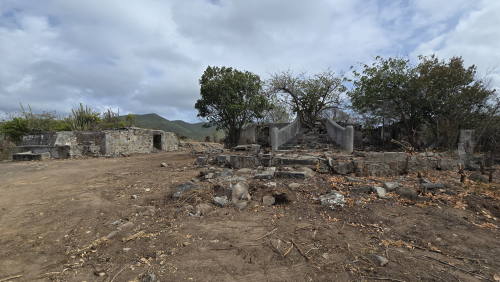
The Belvedere Plantation, which is on the official Monument List, is one of our most important cultural & historical sites and provides an appropriate setting for this annual event. The Belvedere Plantation main house is estimated to have been built around 1840, and research at the site indicates that two sugar factories existed on the plantation, one of which was in close proximity to the main house.

In early December 2025, Minister of VROMI Patrice Gumbs Jr. and Minister of ECYS Melissa D. Gumbs jointly announced the finalization of the purchase of “Belvedere Remainder,” which has a total land area of 288,402 m2 (71.3 acres or 28.8 hectares). The property has been divided into 2 parcels: Belvedere Remainder North and Belvedere Remainder South. The second parcel, “Belvedere Remainder South”, encompassing 158,183 m2, has been allocated to the Ministry of Education, Culture, Youth & Sport.

Minister of Education, Culture, Youth & Sport, the Honorable Melissa Gumbs, said, “The intention is to ensure that restoration projects are prioritized and that development of Belvedere South is strictly aimed at the preservation and promotion of our cultural heritage.

Annually, Emancipation Day is commemorated on July 1st, which was the first public holiday established by the Parliament of Sint Maarten since becoming a Country within the Kingdom of the Netherlands on October 10th, 2010. This year’s theme, entitled “Buss di chain & free your…” encourages all persons in our community to take time to reflect on the impact of Slavery Past and how this experience has affected their past, present and future lives.


Government already planning 2027 Budget as Minister Pushes for earlier submission,

~Finance Minister Marinka Gumbs says reforms introduced in 2026 are already being used to prepare next year's budget months ahead of schedule.~

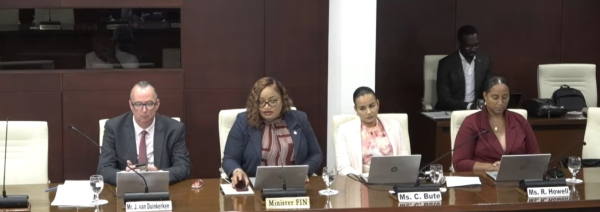
finance26062026PHILIPSBURG:---  While Parliament has only just begun debating the 2026 National Budget, Minister of Finance Marinka Gumbs has already turned the government's attention to 2027, telling Members of Parliament that work on next year's budget is well underway in an effort to finally end years of chronic delays.

The announcement formed one of the key reform initiatives presented during Friday's budget debate. According to Gumbs, the Ministry of Finance has fundamentally changed the budget preparation process by introducing earlier planning, tighter accountability, and stronger coordination among ministries.

"The 2027 budget process began months earlier than in previous years," Gumbs told Parliament. "Ministries have been engaged well in advance, and the necessary structures are now in place to support the timely preparation and submission of future budgets."

The Minister acknowledged that the 2026 budget arrived later than required, describing the delay as part of a longstanding pattern that has affected successive governments. However, she said the structural reforms introduced this year are intended to ensure that late budgets become a thing of the past.

"I want to be clear. While this is not a new phenomenon, I intend that it will be the last time a national budget is presented this late under my leadership," Gumbs declared.

2027 Already Taking Shape

The government's budget presentation provided Parliament with its first look at the financial outlook for 2027.

The Ministry of Finance projects total revenue of Cg 670 million, an increase of Cg 23 million over the 2026 estimate of Cg 647 million.

At the same time, total expenditure is projected at Cg 662 million, or Cg 26 million more than the 2026 operating budget.

Despite the higher spending, the government still expects to post an operating surplus of Cg 8 million in 2027. Although lower than the projected Cg 11 million surplus for 2026, the figures suggest the government expects to maintain balanced budgets over the medium term.

No New Taxes—Yet

One of the more significant revelations in the presentation is that the 2027 projections do not include any new revenue-raising measures.

The presentation specifically states that the proposed tourist levy, estimated to generate approximately Cg 18 million annually, has not been included in the revenue forecast because the legislation has not yet completed the parliamentary approval process.

Instead, the Ministry of Finance expects revenue growth to come mainly from higher collections of wage tax and turnover tax (TOT), while maintaining the tax-to-GDP ratio at approximately 14.2 percent through 2029.

The government also anticipates that contributions under the TWO Country Package will begin declining during 2027 as the programme is expected to wind down after the first quarter, unless it is extended.

Four Years of Budget Surpluses

The financial outlook presented to Parliament projects positive operating balances throughout the entire budget period.

Government forecasts:

  • 2026: Cg 11 million surplus.
  • 2027: Cg 8 million surplus.
  • 2028: Cg 15 million surplus.
  • 2029: Cg 17 million surplus.

Revenue is projected to fluctuate between Cg 639 million and Cg 670 million, while annual expenditure is expected to remain between Cg 624 million and Cg 662 million over the four years.

Changing the Budget Culture

The Minister said the earlier start to the 2027 budget process forms part of a wider effort to transform the culture of public financial management.

The reforms include stronger internal financial controls, improved coordination among ministries, clearer accountability measures, and the continued implementation of policy-based budgeting, which links every allocation to measurable policy objectives rather than simply listing operational expenses.

The objective, according to Gumbs, is to create a disciplined budget cycle in which ministries begin planning months in advance, allowing Parliament sufficient time to scrutinize government spending before the start of each fiscal year.

Whether those reforms succeed will become evident in the coming months. If the Ministry of Finance submits the 2027 National Budget on time, it would mark one of the most significant improvements in St. Maarten's public financial management in many years and signal that the government is finally breaking with the cycle of delayed budgets that has repeatedly drawn criticism from Parliament, the Council of Advice, and the Committee for Financial Supervision (CFT).

Behind the Cg 11 million Surplus: Healthcare, GEBE, PSS and Disaster Risk Threaten St. Maarten’s Finances.

~Budget presentation exposes fragile liquidity, billion-guilder debt, healthcare deficits, and state-owned companies that could force the government back into crisis mode.~

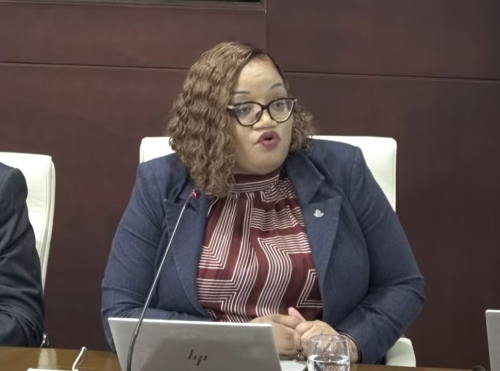
jackiegumbs26062026PHILIPSBURG:---  While Finance Minister Marinka Gumbs presented a 2026 budget with a projected Cg 11 million operational surplus, the deeper figures in government’s own presentation show that St. Maarten’s public finances remain exposed to serious risks that could wipe out that surplus quickly.

The budget projects Cg 647 million in revenue and Cg 636 million in operating expenditure. On paper, that gives the government a positive balance. But the fiscal risk section paints a far more fragile picture: healthcare funds are bleeding money, several state-owned companies remain weak, liquidity is thin, debt remains above one billion guilders, and one major hurricane could severely damage the government’s financial position.

Government’s opening debt for January 2026 is listed at Cg 1.021 billion. A new Cg 42 million capital loan is planned for 2026, while repayments are projected at Cg 17 million. By December 2026, closing debt is projected at Cg 1.047 billion.

The debt-to-GDP ratio is projected at approximately 41 percent based on CBCS figures, down from 43 percent in 2025. The government says the debt remains manageable, especially with economic growth forecast between 2.4 and 2.7 percent. But the presentation also warns that St. Maarten’s small, open, tourism-dependent economy remains vulnerable to hurricanes, oil shocks, inflation, global instability, and downturns in visitor arrivals.

The liquidity position is even tighter. Government projects an opening cash balance of Cg 13 million and an estimated year-end balance of only Cg 5 million. Total receipts are projected at Cg 571 million, while total payments are projected at Cg 578 million.

That means the government is projecting a surplus in its operating budget while ending the year with dangerously limited free liquidity.

Capital investments for 2026 are listed at approximately Cg 163 million. The largest portion, Cg 79 million, is listed under other equipment, including IT and operational needs. ICT equipment accounts for Cg 36 million, land improvements Cg 25 million, non-residential buildings Cg 10 million, transport vehicles Cg 4 million, and other capital items Cg 9 million.

Gumbs told Parliament that the government is borrowing strictly to build, not to cover operational waste. She said the new Cg 42 million investment loan will be tied to strict multi-year project timelines to avoid the past practice of borrowing funds that sit unused while interest continues to accumulate.

But the most explosive risk remains healthcare.

The Minister told Parliament that healthcare funds managed through SZV are losing approximately Cg 35 million annually and that the accumulated deficit has reached approximately Cg 500 million. The risk presentation goes even further, warning that annual healthcare deficits are closer to Cg 50 million and that reserves are projected to fall from Cg 299 million in 2024 to approximately Cg 178 million by 2029.

For more than a decade, according to the Minister, the government has covered healthcare losses by relying on reserves connected to the national pension fund. Gumbs warned that this can no longer continue and that failure to act could threaten both healthcare access and the wider social safety net for seniors.

The government’s proposed solution includes General Health Insurance, a tourist levy, and tax reform aimed at widening the tax base and improving compliance. The planned tourist levy is expected to generate approximately Cg 18 million, but that amount is not included in the 2027 projections because the legislation has not yet been completed.

State-owned companies are another danger zone.

The presentation identifies GEBE as a major concern. The utility company has not had audited financial statements since 2021. The 2022 cyberattack and 2024 engine failures severely damaged operations, and the government has backed a Cg 75.6 million loan connected to GEBE.

For a monopoly utility that provides electricity and water to the entire country, that is not a small administrative weakness. It is a direct national risk.

TelEm is under restructuring after recording a Cg 38.4 million loss in 2023, although the government says much of that was one-off and that the underlying loss was closer to Cg 6 million. A Cg 4 million loss is expected for 2024, showing some improvement but not yet a full turnaround.

PSS remains financially fragile and unsustainable without government operating subsidies. Improvement measures are underway, but the presentation admits results will take time.

At the same time, not all state-owned companies are weak. Port St. Maarten recorded a 2024 profit of US $11.2 million, up from US $8 million in 2023. By the second quarter of 2025, the port reported US $9.5 million in net result and US $74.4 million in cash, although major Pier 1 capital investment is still needed.

Winair posted a 2024 profit of US $3.7 million and recorded US $4.3 million in net profit for the first three quarters of 2025, while its COVID loan has been fully repaid. PJIAE also showed strong results, with a 2024 profit of Cg 21.1 million, up Cg 9.5 million from 2023. Its EBITDA margin for Q2 2025 stood at 47.8 percent, with approximately 1.5 million passengers projected for 2025.

The message is clear: some government companies can perform when properly managed, while others remain a burden on the public purse.

Gumbs said the government will now move toward an active participation policy, requiring quarterly financial reporting, standardized dividend policies, stronger corporate governance, and binding restructuring agreements. She said taxpayers’ money will not be used to reward bad management or corporate opacity.

The budget also identifies other risks. A major hurricane could severely damage revenue and push debt above sustainable levels. The aging population is placing more pressure on pensions and healthcare, with the 65-plus age group increasing from 5 percent in 2011 to 13 percent in 2022. Global economic volatility remains a threat because St. Maarten depends heavily on tourism, airline access, and imported fuel.

Government is therefore not only asking Parliament to approve a budget. It is asking Parliament to trust that reforms will happen fast enough to prevent the next financial crisis.

The figures show a government with a surplus on paper, but very little room for error. If healthcare reform stalls, if GEBE remains unaudited, if PSS continues needing subsidies, if TelEm fails to recover, or if a major hurricane strikes, the Cg 11 million surplus could disappear overnight.

The budget debate must therefore go beyond speeches. Parliament now has the figures in front of it. The question is whether Members of Parliament will demand hard timelines, audited accounts, enforcement mechanisms, and measurable results — or whether St. Maarten will once again wait until the numbers become a crisis.

Budget 2026 Balloons to Cg 647 million as Government Promises Results, Not Excuses,

~Finance Minister Marinka Gumbs says St. Maarten is moving from line-item spending to policy-based budgeting, but the numbers show a government machinery growing fast.~

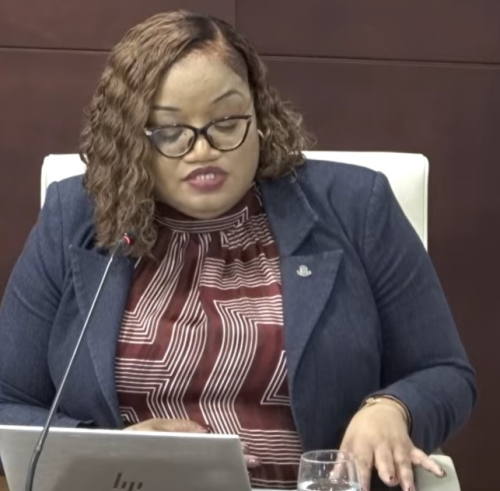
mjgumbs26062026PHILIPSBURG:---  Finance Minister Marinka Gumbs placed a Cg 647 million revenue budget before Parliament on Friday, calling it a historic shift in how St. Maarten manages public money, while also admitting that the budget was again submitted later than it should have been.

The 2026 draft budget projects Cg 647 million in revenue against Cg 636 million in operating expenditure, leaving the government with a projected operational surplus of Cg 11 million. Compared to the 2025 budget, revenues increase by Cg 61 million from Cg 586 million, while expenditure increases by Cg 58 million from Cg 577 million.

The Minister described the budget as the first national budget prepared under a policy-based budgeting framework, moving away from the old system where the government simply listed what it would spend on salaries, rent, supplies, and utilities. Under the new system, ministries must explain why money is being spent, what outcomes are expected, and how Parliament can measure delivery.

Gumbs told Parliament that St. Maarten is “shifting from inputs to impact,” arguing that taxpayers must be able to see a direct link between the taxes they pay and the improvements government claims it will deliver.

But behind the language reform, the figures show a government budget that is expanding rapidly.

Taxes remain the backbone of government revenue, with Cg 478 million projected for 2026, representing 74 percent of total income. Other revenue, including project funds, is projected at Cg 91 million, or 14 percent. Fees and concessions are estimated at Cg 62 million, while licenses account for Cg 16 million.

On the expenditure side, personnel costs show one of the most significant increases. Personnel expenditure rises from Cg 223 million in 2025 to Cg 279 million in 2026. Goods and services jump from Cg 127 million to Cg 167 million. Subsidies remain high at Cg 109 million, compared to Cg 107 million in 2025. Social provisions decline from Cg 42 million to Cg 36 million, while interest remains heavy at Cg 26 million.

The increase in personnel is linked to filling vacancies, a 2.5 percent salary indexation, and project-related staffing. The increase in goods and services is attributed mainly to temporary TWO project-related operational spending, which the government says should decline after 2027.

Education, Culture, Youth, and Sport receive the largest ministry allocation at Cg 126 million, representing 21 percent of the ministerial budget. Justice follows with Cg 114 million, or 19 percent. VSA receives Cg 109 million, Finance Cg 91 million, General Affairs Cg 90 million, TEATT Cg 41 million, and VROMI Cg 37 million.

That means the three largest spending areas — Education, Justice, and VSA — together account for Cg 349 million, more than half of the consolidated ministerial budget of Cg 608 million.

The first-quarter results for 2026 gave the government a stronger starting position. For Q1, the government recorded Cg 171 million in revenue and Cg 132 million in expenses, producing a Cg 39 million result. Compared to the 2026 budget projection for the same period, revenue was Cg 9 million higher and expenses were Cg 27 million lower.

The higher revenue was driven largely by stronger tax collection, especially profit tax. Expenses were lower due to Cg 10 million less in personnel spending and Cg 14 million less in goods and services. Compared to Q1 2025, revenue increased by Cg 8.8 million, while expenses increased by Cg 7.3 million, mainly due to Cg 6.1 million more in payroll expenses.

Gumbs acknowledged that the late submission of the budget remains a serious problem. She said she would not offer excuses or shift blame, but would take responsibility for strengthening the system. She said the 2027 budget process has already started earlier than in previous years, with ministries engaged in advance to avoid another late submission.

The multi-year outlook projects continued surpluses: Cg 11 million in 2026, Cg 8 million in 2027, Cg 15 million in 2028, and Cg 17 million in 2029. However, the 2027 outlook also shows revenue rising to Cg 670 million and expenditure climbing to Cg 662 million.

Notably, the planned tourist tax, estimated at approximately Cg 18 million, is not included in the 2027 revenue projections because the legislative process has not yet been completed.

The central question for Parliament is whether this new budget system will truly produce measurable results, or whether St. Maarten will simply continue spending more money under a new name.

For years, budgets have come late, annual accounts have lagged, and Parliament has been forced to debate financial plans without always having the full picture of past performance. Gumbs is now promising a break from that pattern.

The numbers give her government room to claim progress. The challenge is proving that Cg 647 million will not simply finance a bigger bureaucracy, but produce better schools, safer communities, stronger healthcare, functioning infrastructure, and real accountability.

Finance Minister Vows End to late budgets, unveils historic policy-based 2026 budget.

~Minister Marinka Gumbs promises structural reforms, stronger financial discipline, healthcare overhaul, and active oversight of government-owned companies~
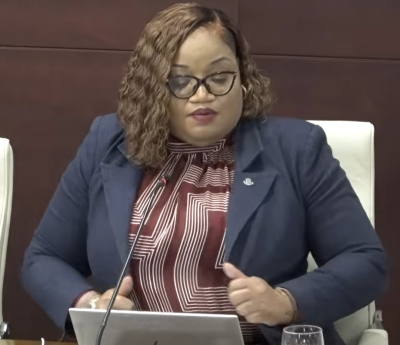
marinkagumbs26062026PHILIPSBURG:---  Minister of Finance Marinka Gumbs used the opening of Parliament's Central Committee meeting on Friday to acknowledge years of delays in the country's budget process while pledging that the 2026 National Budget would be the last to arrive late under her leadership.

Presenting what she described as a historic shift in the way St. Maarten manages public finances, Gumbs admitted that the delayed submission of the budget was unacceptable but insisted that the government has now fundamentally restructured the budgeting process to prevent similar delays in the future.

"This budget is being presented later than it should have been," Gumbs told Parliament.

"I want to be clear. While this is not a new phenomenon, I intend that it will be the last time a national budget is presented this late under my leadership."

Rather than blaming previous administrations, Gumbs accepted responsibility for correcting what she described as long-standing structural weaknesses in government.

"I offer no excuses, nor do I seek to assign blame. I take full ownership of my role and responsibility as Minister of Finance."

She acknowledged that deadlines had not been consistently enforced, accountability had been insufficient, and coordination between ministries had often broken down, contributing to repeated delays over many years.

First Policy-Based Budget in St. Maarten's History

Central to the Minister's presentation was what she described as the first policy-based budget ever produced by the Government of St. Maarten.

Unlike previous budgets that largely focused on online-item expenditures such as salaries, utilities, and office supplies, the new approach is designed to connect every government dollar directly to policy objectives and measurable outcomes.

According to Gumbs, Parliament will now be better equipped to evaluate whether ministries are actually delivering on their promises rather than merely spending allocated funds.

"We are no longer simply presenting expenditures," she explained.

"We are explaining why resources are being allocated, what concrete outcomes we expect to achieve for the people, and how every single guilder aligns with our strategic policy objectives."

She described the transition as "a massive leap forward" that shifts government from short-term spending toward long-term planning while giving taxpayers a clearer understanding of how public money is being used.

Credit Given to Former Finance Minister Ardwell Irion

In a notable bipartisan gesture, Gumbs publicly acknowledged MP Ardwell Irion, who previously served as Minister of Finance.

She credited Irion with initiating the transition toward policy-based budgeting during his tenure, saying the current administration had built upon that foundation to produce the 2026 Budget.

"The work laid out the foundation for the reforms we continue today," she said.

The Minister also disclosed that work on the 2027 Budget has already started months earlier than previous years, with ministries engaged well in advance to ensure future budgets are submitted on time.

Operational Surplus Despite Larger Budget

The Minister outlined a significantly expanded fiscal framework for 2026.

Government projects:

  • Revenue: CG 646 million
  • Operating expenditure: CG 636 million
  • Operational surplus: CG 11 million

She emphasized that the government's day-to-day operations will be financed through current revenues rather than borrowing.

At the same time, the government plans to invest CG 164.6 million in capital projects aimed at strengthening infrastructure and economic development.

Those investments will be financed through carefully managed capital borrowing rather than operational borrowing.

"We are borrowing strictly to build, not to cover operational waste," Gumbs declared.

Debt Remains Manageable

Addressing concerns about government borrowing, Gumbs said St. Maarten's debt remains within internationally accepted levels.

According to the Minister, the country's debt-to-GDP ratio is projected to decline from 43 percent in 2025 to approximately 41 percent in 2026, remaining below the 45 percent level generally regarded as manageable for Caribbean economies.

She nevertheless warned that St. Maarten remains highly vulnerable to external shocks, including global oil prices, geopolitical instability, inflation, climate events and fluctuations in tourism.

The Minister said every dollar required to service government debt has already been included in the operational budget and confirmed that government remains fully compliant with the borrowing standards established by the College financieel toezicht (CFT).

She also announced that government's new CG 42 million capital investment loan will be tied to strict project timelines to ensure borrowed funds are actually utilized instead of sitting idle while interest accumulates—an issue repeatedly criticized by the CFT in previous years.

Healthcare Deficit Described as Greatest Financial Threat

Perhaps the most alarming portion of the Minister's presentation centered on the country's healthcare finances.

Gumbs revealed that the healthcare funds administered by the Social and Health Insurances (SZV) continue to lose approximately CG 35 million annually.

For more than a decade, she said, those losses have been covered by drawing from the reserves of the national pension fund (AOV), creating what has now become an accumulated deficit of approximately CG 500 million.

"If we do not act immediately," she warned, "we are not just risking the collapse of healthcare access—we are risking the collapse of the entire social safety net that our seniors rely on."

To address the crisis, the government plans a three-pronged strategy consisting of:

  • Implementation of the Sustainable Affordable Access Healthcare Act (SAHA), formerly referred to as General Health Insurance.
  • Introduction of a tourist levy dedicated to supporting the social security system.
  • Comprehensive tax reform is designed to broaden the tax base and improve compliance.

Rather than relying on emergency financing, Gumbs said the government intends to implement structural reforms that permanently stabilize healthcare financing.

Government Tightens Grip on State-Owned Companies

The Minister also addressed the financial condition of government-owned companies following observations made by the CFT.

While praising the financial performance of Port St. Maarten, which recorded approximately CG 11.2 million in net profit during 2024, and Princess Juliana International Airport Operating Company, which earned approximately CG 21.1 million following completion of the airport reconstruction, Gumbs acknowledged that other government-owned entities continue facing significant financial challenges.

She specifically identified NV GEBE, TelEm, and Postal Services St. Maarten (PSS) as requiring major reforms.

According to Gumbs, the government intends to abandon what she described as years of passive ownership by introducing:

  • mandatory quarterly financial reporting;
  • standardized corporate governance requirements;
  • dividend policies;
  • stronger shareholder oversight; and
  • binding restructuring agreements with troubled companies.

For NV GEBE, the government plans stricter operational audits, stronger protection of the electricity grid, and greater investment in renewable energy to reduce long-term generation costs.

For TelEm, the government intends to support modernization efforts aimed at creating a more competitive telecommunications provider.

"We are not going to use taxpayers' money to bail out bad management or reward corporate opacity," the Minister declared.

"The days of passive government ownership are over."

Call for Accountability

Gumbs concluded by describing the 2026 Budget as an honest reflection of both government successes and shortcomings.

She stressed that Parliament now possesses measurable benchmarks against which every ministry can be judged.

"This policy-based budget gives Parliament the precise tools it needs to hold my ministry and all other ministries accountable."

She urged Members of Parliament to engage in constructive debate focused on strengthening public finances rather than political point scoring.

"I do not present this budget as a perfect document," she said.

"But I present it as an honest document."

The Minister's presentation marked the official start of Parliament's examination of the 2026 National Budget, which is expected to dominate parliamentary discussions over the coming weeks as Members scrutinize the country's fiscal priorities, borrowing plans, healthcare reforms and long-term economic strategy.


Subcategories