"Judge Draws the Line at Mullet Bay: Beach Belongs to the Public, Government Ordered to Respect Private Property Behind Shoreline."
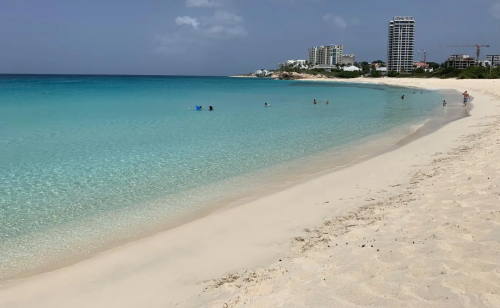 PHILIPSBURG:--- In one of the most consequential property rulings in recent years, the Court of First Instance has ruled that Mullet Bay Beach is public property, rejecting Sun Resorts Limited's attempt to establish private ownership over the island's renowned beach while simultaneously confirming that the company remains the lawful owner of the land situated behind the beach.
The judgment, handed down on July 7, 2026, under ECLI:NL:OGEAM:2026:84, brings legal clarity to a dispute with implications not only for Mullet Bay but also for the interpretation of beachfront ownership throughout St. Maarten.
At the heart of the case was Sun Resorts' contention that an 1852 notarial deed transferred ownership of the former Mullet Bay plantation, including the beach extending to the sea. The company argued that the historical description of the property, together with subsequent cadastral registrations and decades of ownership, established that the beach itself formed part of its private estate.
The Court, however, rejected that interpretation after conducting an extensive review of historical deeds, colonial legislation, cadastral records, Roman Dutch legal principles, and the Civil Code.
The judge concluded that the wording contained in the nineteenth-century deed did not convey ownership of the sandy beach itself. Instead, the Court found that references to the property's boundary at the sea merely described the plantation's limits and did not transfer ownership of the public shoreline.
The Court further held that, under the legal principles governing St. Maarten since the nineteenth century, the beach forms part of the public domain. Beaches have historically been intended for public use and enjoyment and cannot be presumed to become private property simply because adjacent land is privately owned.
Prescription Claim Also Fails
Sun Resorts alternatively argued that even if the original deed did not transfer ownership of the beach, it had nevertheless acquired ownership through prescription after exercising control over the area for many decades.
The Court dismissed that argument as well.
The judge found that the evidence presented failed to establish the continuous, exclusive, unequivocal and public possession required by law to obtain ownership through prescription. The Court noted that public access to Mullet Bay Beach has existed for generations and that the company failed to demonstrate sufficient acts of ownership to extinguish the beach's public character.
Government also found to have acted unlawfully
While Sun Resorts lost its claim over the beach itself, the company prevailed on another major aspect of the litigation.
The Court ruled that the land located behind the public beach, extending inland from the normal high-water line, remains the private property of Sun Resorts.
According to the judgment, the Government of St. Maarten unlawfully treated portions of that privately owned property as government land by granting rights and allowing third parties to occupy or use the area despite lacking ownership.
The Court ordered the Government to immediately cease presenting itself as the owner of those lands and prohibited it from leasing, licensing or otherwise granting rights over property belonging to Sun Resorts.
To ensure compliance, the Court imposed exceptionally severe penalties.
Should the Government again interfere with Sun Resorts' ownership rights, it faces a US$1 million penalty for each violation.
In addition, the Government has been ordered to notify all affected third parties within 14 days that it is not the owner of the disputed parcels and therefore lacked authority to issue leases, permits or other rights over the property. Failure to comply with that order carries an additional penalty of US$10,000 per day, up to a maximum of US$250,000.
Kalatua Property Addressed
The judgment also examined the area currently occupied by the Kalatua beach establishment.
Sun Resorts argued that the restaurant is not situated on the public beach but on privately owned land behind the shoreline, explaining that vegetation and trees had previously existed there before the site was cleared for development.
The Court observed that the Government did not meaningfully dispute those factual assertions during the proceedings, strengthening Sun Resorts' position regarding ownership of the land behind the beach.
Historical Documents Examined
A significant portion of the judgment is devoted to the Court's examination of historical documents dating back more than 170 years.
The judge analyzed the 1852 conveyance deed, subsequent cadastral maps, historical boundary descriptions, and applicable legislation governing coastal property. The Court concluded that none of those documents demonstrated an intention to privatize the sandy beach itself.
The ruling also distinguishes between ownership of upland property and the beach's public nature. According to the Court, ownership of land bordering the coastline does not automatically include ownership of the beach extending to the sea.
Major Precedent for St. Maarten
Legal observers are expected to view the decision as one of the most important rulings on coastal property rights in St. Maarten in recent years.
The judgment confirms that beaches remain accessible to the public while simultaneously reinforcing constitutional and property-law protections for privately owned land adjoining those beaches.
For residents and visitors alike, the decision means that Mullet Bay Beach remains a public beach. At the same time, the Government cannot treat privately owned land behind the shoreline as public property or grant rights over such land without lawful authority.
The ruling is expected to influence future disputes involving beach access, coastal development, government leases, tourism projects and shoreline management across St. Maarten, providing a clearer legal framework for determining where the public beach ends and private ownership begins.
Click here for the official court verdict.