~Tackling tells Parliament St. Maarten's roads are becoming deadlier despite fewer accidents as she calls for modern traffic laws, stronger budgets and shared national responsibility~
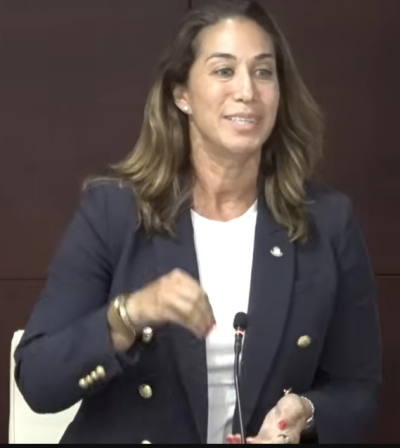 PHILIPSBURG:--- Justice Minister Nathalie Tackling delivered a sobering message to Parliament on Tuesday, arguing that while St. Maarten is recording fewer traffic accidents overall, those that do occur are becoming increasingly deadly. She warned Members of Parliament that expecting police enforcement alone to reverse the trend is unrealistic without legislative reform, additional funding, and a coordinated national strategy involving multiple ministries.
Opening the urgent public meeting requested by MPs Lyndon Lewis, Omar Ottley and Francisco Lacroes, Tackling began by focusing on the human cost behind the statistics.
"Nine people have died on our roads this year. Nine people in eight separate accidents. Every one of them left a family behind. Every one of them left an empty chair at a table somewhere on this island," she told Parliament.
The Minister also addressed criticism regarding the scheduling of the meeting, explaining that Parliament's request only reached her office late and that she postponed the meeting by one day solely to ensure she could provide comprehensive answers rather than appear unprepared.
Fewer accidents, but far more fatalities
Presenting detailed statistics, Tackling said police records show traffic accidents have steadily declined over the past three years.
- 2024 (Week 27): 812 accidents
- 2025 (Week 27): 719 accidents
- 2026 (Week 27): 681 accidents
However, road deaths have moved sharply in the opposite direction.
- 2024: 7 deaths
- 2025: 4 deaths
- 2026: 9 deaths already, with half the year still remaining.
"The honest headline is not that accidents are rising," she told Parliament. "Accidents are falling. The honest headline is that our accidents have become deadlier."
According to the Minister, five of this year's nine fatalities involved motorcycles or scooters, with police investigations showing many crashes stemmed from reckless rider behavior, including:
- riders losing control,
- performing dangerous wheelies,
- driving on the wrong side of the road,
- crashing into stationary vehicles,
- unsafe overtaking maneuvers.
She stressed that while every fatality deserves serious attention, not every tragedy could have been prevented through police enforcement alone.
Among this year's fatalities were:
- a driver who suffered a fatal heart attack while behind the wheel,
- an intoxicated pedestrian who walked into the path of a garbage truck,
- two occupants killed after a single vehicle left the roadway.
"A heart attack behind the wheel is not an enforcement failure," she said. "No checkpoint would have changed that."
Police are working, despite public criticism
Rejecting suggestions that law enforcement is failing to address dangerous driving, Tackling presented enforcement figures demonstrating significant police activity during the first half of 2026.
Police have already conducted approximately 60 traffic control operations this year.
Traffic fines issued include:
- 2024: 2,448
- 2025: 3,236
- 2026 so far: 1,095
Police have also:
- confiscated 31 firearms this year,
- crushed 150 seized scooters, with another 60 scheduled for destruction,
- taken 96 scooters into custody,
- seized 43 vehicles and eight scooters for forfeiture proceedings.
"The numbers say otherwise," she said in response to claims that police are doing little in terms of enforcement.
"When I hear that nothing is being done, I have to push back—not for my sake, but for theirs," she said, referring to frontline police officers.
Police operating at only 56 percent strength
Perhaps the most striking revelation came when Tackling outlined the severe manpower shortages facing the Police Force of St. Maarten (KPSM).
She revealed that the force currently operates with only 189 employees out of an approved establishment of 332 positions—just 56 percent staffing.
Of those officers, only about 70 Basic Police Care officers are responsible for:
- responding to every 911 emergency,
- handling neighborhood disputes,
- policing major events,
- carrying out traffic enforcement,
- guarding detainees,
- providing dignitary protection,
- responding to criminal incidents island wide.
The dedicated Traffic Department itself consists of only four officers, whose primary responsibility is investigating accidents rather than conducting road enforcement.
"There is no traffic team waiting in reserve," Tackling warned.
"More enforcement on one issue means less enforcement somewhere else."
Major legal gaps limit enforcement
The Minister argued that outdated legislation significantly weakens police enforcement efforts.
She disclosed that St. Maarten currently lacks:
- legal blood alcohol limits,
- legislation permitting roadside breath testing,
- operational breathalyzer equipment,
- speed camera legislation,
- authority for license plate-based enforcement,
- modern provisions covering distracted driving, street racing, e-bikes, quads and electric scooters.
She also revealed that many speeding tickets fail in court because roads lack legally required speed limit signs and road markings.
"Where the road authority has not made the rule visible, the court voids the fine," she explained.
Equally concerning, police cannot safely pursue fleeing scooter riders because high-speed pursuits often create greater risks than the original traffic offense.
Instead, Tackling said future enforcement should focus on technology, including camera systems and license plate recognition.
A modern traffic law remains stalled
One of the Minister's strongest criticisms centered on an unfinished modernization of St. Maarten's Traffic Ordinance.
She disclosed that years ago, the government commissioned a complete revision of the law with input from multiple stakeholders.
However, the consultant responsible for completing the work was never paid.
As a result, the complete draft legislation has remained locked away for years.
"It sits there to this day," she said.
"A finished piece of the solution locked away over an unpaid invoice."
She pledged to revive the legislation, but warned Parliament that passing the law alone would not solve the problem without simultaneously funding cameras, breathalyzers, patrol vehicles, digital enforcement systems and additional personnel.
Parliament challenged fund public safety
Throughout her presentation, Tackling repeatedly emphasized that Justice cannot solve road safety alone.
She identified four pillars necessary to reduce fatalities:
- Attitude,
- Personal responsibility,
- Prevention,
- Enforcement.
Justice, she argued, controls only one of those four.
Road infrastructure remains under VROMI.
Driving instruction falls elsewhere.
Taxi and transport permits are issued by TEATT.
Traffic education belongs with Education.
Insurance regulation, planning decisions and budget allocations also lie outside Justice's authority.
"Solving this needs every ministry, and it needs this Parliament," she declared.
MPs challenge budget decisions
The Minister's repeated references to budget constraints immediately drew reactions from MPs Ardwell Irion and Egbert Jurendy Doran.
Irion questioned why none of the proposed traffic safety measures appeared in the already approved 2027 draft budget.
Tackling responded that her ministry cannot even fully finance its existing obligations under the current allocation.
"If we have to choose between obligations that we have within the Kingdom... at the end of the day it's do I pay salaries or do I spend money for our traffic ordinance? The pie is simply too small," she said.
Doran reminded the Minister that Cabinet had unanimously approved the draft budget, arguing that the absence of these initiatives reflected decisions made by government itself.
Tackling replied that while ministers approve a draft budget in the Council of Ministers, Parliament ultimately controls appropriations and possesses the authority to amend the budget before final approval.
Roseburg offers parliamentary assistance
In one of the more constructive exchanges of the meeting, MP Sjamira Roseburg suggested that Parliament could assist by reviewing the unpaid invoice preventing the completion of the modern Traffic Ordinance.
She asked the Minister to provide the outstanding invoice, even confidentially if necessary.
Tackling immediately agreed, saying the information would be provided to Parliament for consideration.
Final appeal
Closing her nearly hour-long presentation, Tackling urged Parliament to move beyond assigning blame and instead support meaningful legislative reform and adequate funding.
She warned legislators that demanding stronger enforcement while simultaneously reducing Justice's financial resources is ultimately unsustainable.
"It is not consistent to demand more enforcement in July and cut the means for it in December," she concluded, urging Parliament to help modernize traffic laws, finance enforcement tools and ensure future budgets match the expectations placed on police officers.