~GEBE explains temporary container units removed, €70 million project faces shortfall, while Seven Seas negotiations remain in the government's hands.~
 PHILIPSBURG:--- St. Maarten's long-awaited replacement power generators have not yet been ordered despite approximately €70 million in Dutch funding being made available for the project, GEBE officials revealed Friday, as questions continue to surround the island's future energy security and dependence on Seven Seas Water.
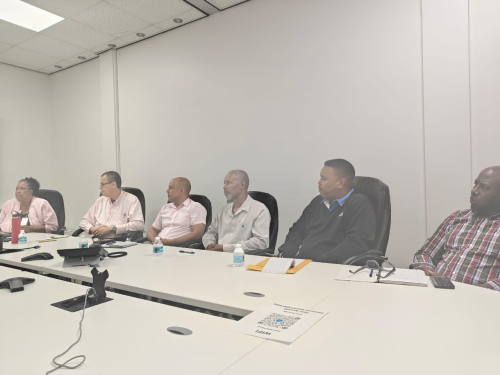
During a press conference, Temporary Manager Iris Arrindell and members of GEBE's management team provided updates on the utility's power generation plans, the removal of temporary container generators, and why the utility has not moved forward with purchasing the island's water production facility.
The disclosures came in response to a series of questions from members of the media about GEBE's infrastructure plans and long-term strategy.
NEW GENERATORS STILL NOT ORDERED
One of the most significant revelations was that the new power generators intended to replace aging units at the Cay Bay Power Plant have not yet been ordered.
Arrindell confirmed that although approximately €70 million in financing has been identified for the project, rising global costs and geopolitical developments have created a funding shortfall.
According to Arrindell, discussions are ongoing with generator manufacturer Wärtsilä to determine the exact amount required to bridge the gap before production can begin.
"We are in a phase now where we have a shortfall that we have to find a way to cover," Arrindell said.
She explained that a meeting was recently held with stakeholders and that additional discussions are expected in July.
While she declined to provide a specific dollar figure for the funding gap, Arrindell acknowledged that increased demand for power generation equipment worldwide and changing market conditions have pushed costs beyond initial projections.
The delay means the utility remains dependent on generators that in many cases have already exceeded their intended operational lifespan.
CONTAINER GENERATORS REMOVED
Management also provided an update on the temporary containerized generators that were brought to St. Maarten during the island's power crisis to help stabilize electricity production.
Distribution Manager Patrick Davis explained that the container units were part of a three-stage recovery strategy consisting of short-term, medium-term and long-term solutions.
The temporary units, which provided approximately 10 megawatts of generation capacity, have now been removed.
According to Davis, a technical assessment concluded that the existing generation fleet could continue operating without additional temporary capacity.
"The short-term solution was a 10-megawatt plant," Davis explained. "Those units were sent away earlier this year."
The utility is now relying on what officials described as the medium-term solution, consisting of approximately 20 megawatts of generation capacity currently available within the system.
The long-term solution remains the acquisition and installation of the new Wärtsilä generators.
QUESTIONS ABOUT WATER PRODUCTION
The issue of water production also generated significant discussion.
Responding to questions about why GEBE has not purchased the Seven Seas Water desalination plant, officials emphasized that negotiations regarding the facility are handled by the Government of St. Maarten and not by the utility company.
According to management, the current arrangement with Seven Seas has been extended until 2027 while negotiations continue.
"GEBE has no part in that," GEBE manager Patrick Drijvers said.
He explained that GEBE's role is limited to advising government on the island's water consumption needs, storage requirements and production capacity necessary to meet demand.
The utility does not participate in contract negotiations and does not sign agreements between government and Seven Seas Water.
BUYING THE PLANT NOT AS SIMPLE AS IT SOUNDS
While public discussion often focuses on the possibility of GEBE acquiring its own water production facility, management cautioned that such a move would require substantial investment.
Officials noted that replacing or purchasing a desalination plant would involve costs comparable to those associated with acquiring new power generators.
"It doesn't happen as easily as people think," Drijvers said.
"The plant is a third-party asset. If you have to reinvest in an entire new plant, that costs basically the same as generators."
Management suggested that maintaining productive negotiations and securing favorable contractual terms may prove more practical than attempting to acquire and operate the facility outright.
WATER SUPPLY AGREEMENT WITH FRENCH SIDE NEVER MATERIALIZED
Another issue raised during the press conference was a previously discussed arrangement that would have allowed GEBE to supply water to the French side of the island.
According to Davis, the physical interconnection between the two sides of the island remains in place and testing was conducted to ensure water quality met requirements.
However, despite the infrastructure being available, the arrangement never progressed beyond preliminary stages.
"We never opened the bank," Davis said.
While the French side initially expressed interest in purchasing water, no formal request was ultimately made to begin regular supply operations.
LOOKING TO FUTURE TECHNOLOGIES
Questions were also raised about whether GEBE has explored technologies that could improve efficiency by combining electricity generation with water production.
One example mentioned was Wärtsilä's freshwater distillation technology, which uses waste heat from generators to produce potable water.
Management indicated that such options may be examined as part of broader infrastructure planning, although no commitments were announced.
At the same time, GEBE acknowledged that it remains behind in implementing several requirements contained within its concession agreement, including policies related to alternative energy and net metering.
Arrindell said committees are being established to address those issues and develop recommendations for the future.
ISLAND'S INFRASTRUCTURE FACING GROWING DEMANDS
Officials also confirmed that communication between GEBE and government agencies has improved as new development projects continue across the island.
The utility said it is now receiving more information regarding upcoming construction projects, allowing planners to better assess future electricity and water demands.
Management stressed that meeting future demand will require more than new generators.
Additional investments in transmission infrastructure, distribution networks and water systems will also be necessary to support the island's continued growth.
For now, however, GEBE's immediate focus remains securing funding for the new generators, maintaining reliable service with existing equipment and ensuring that future negotiations concerning water production provide long-term security for the country.
With aging generators, growing demand and unresolved questions surrounding water production, the utility faces a critical period that will shape St. Maarten's energy and water future for years to come.