 PHILIPSBURG:--- The 2026 Budget presents another significant allocation to the Ministry of Justice, but the real question facing taxpayers is whether Sint Maarten is investing in public safety or merely financing the continuation of long-standing institutional problems.
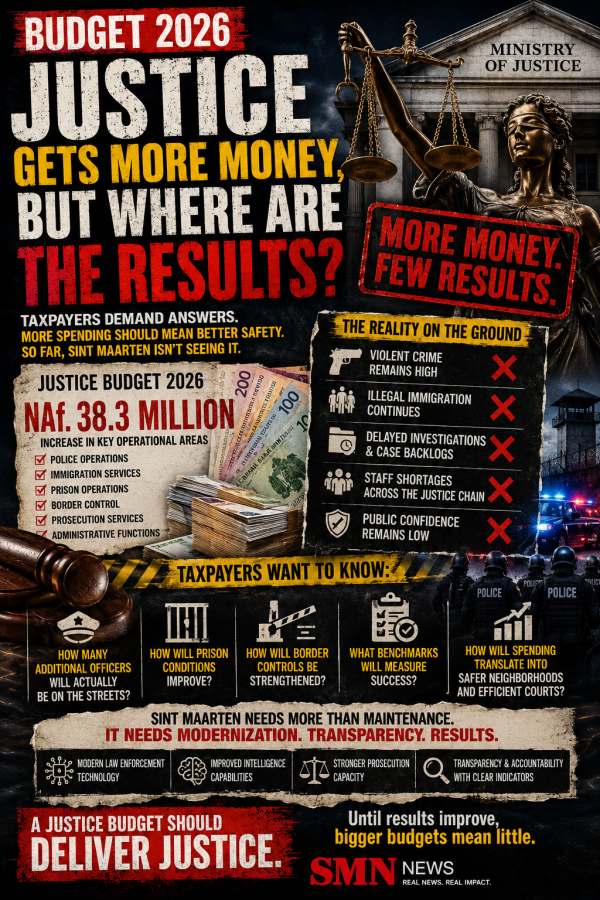
The proposed Justice budget exceeds previous years' levels in several key operational categories, including prisons, immigration services, police operations, border control, prosecution services, and related administrative functions. Yet nowhere in the budget is there a convincing explanation of how these expenditures will translate into measurable improvements in crime reduction, border security, or judicial efficiency.
Residents continue to experience concerns regarding violent crime, illegal immigration, delayed investigations, and chronic staffing shortages throughout the justice chain. Despite recurring annual allocations, public confidence in the justice system remains fragile. The budget therefore raises an uncomfortable question: are larger allocations producing better outcomes?
Particularly troubling is the continued emphasis on operational spending rather than structural reform. Salaries, personnel costs, and routine operational expenses dominate expenditure lines, while transformative investments appear limited. Citizens are entitled to know how many additional officers will actually reach the streets, how prison conditions will improve, how border controls will be strengthened, and what benchmarks will be used to evaluate success.
The budget also arrives against a backdrop of regional security challenges. Criminal networks do not respect borders, and Sint Maarten remains vulnerable due to its unique geographic and economic position. In such circumstances, simply maintaining current systems is insufficient. The country HIT requires modernization of law enforcement technology, improved intelligence capabilities, stronger prosecution capacity, and greater transparency regarding performance indicators.
A justice budget should not merely fund institutions; it should deliver justice. Yet the 2026 proposal provides limited evidence that the government has linked spending to measurable outcomes. Without clear targets and public accountability mechanisms, taxpayers may once again be asked to finance a larger justice apparatus without receiving greater security in return.
The central issue is not whether justice deserves funding. It unquestionably does. The issue is whether the government can demonstrate that increased spending will finally produce safer neighborhoods, more efficient courts, and stronger public trust. Until those answers are provided, the 2026 Justice budget remains more notable for its size than for its vision.