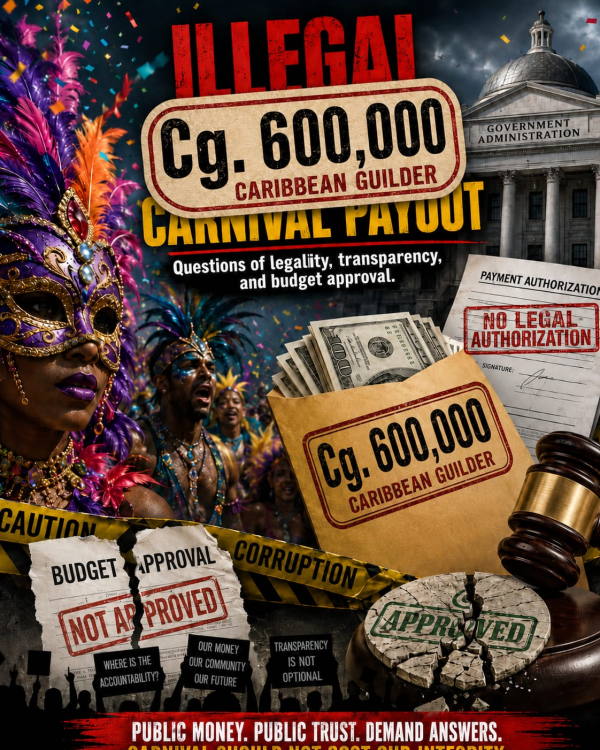
 PHILIPSBURG:--- The 2026 budget debate is expected to begin on June 26, but a review of the draft budget documents and the advice issued by the Council of Advice already reveals a series of serious concerns about the government's handling of public finances. Among the most striking findings is a Cg. 600,000 contributions for Carnival that appear in the 2026 budget despite the fact that no such allocation was included in the 2025 budget, and Carnival 2025 has already taken place.
In its advice on the 2026 draft budget, the Council of Advice specifically highlighted the inclusion of a Cg. 600,000 allocation for Carnival under Verzamelstaat G, the schedule of subsidies, contributions, and income transfers. The Council noted that the 2025 budget contained no allocation for a Carnival contribution. Because the event has already taken place, the Council warned that any contribution that was promised, committed, or paid may be in conflict with Article 16, paragraph 3, of the Comptabiliteitslandsverordening.
That provision concerns the fundamental principle that government expenditures must have proper budgetary coverage before public funds can be committed or spent. In practical terms, government cannot legally promise, obligate, or disburse public money without an approved budgetary basis. If the Cg. 600,000 was promised or paid before Parliament approved the necessary allocation, then the expenditure may have occurred without the required legal authorization.
The Council of Advice therefore recommended that government ensure future subsidies and contributions are arranged in a timely manner and backed by the required budgetary approvals in order to avoid conflicts with Article 16, paragraph 3, of the Comptabiliteitslandsverordening.
Government's response to that recommendation was brief and direct: "De regering volgt het advies van de Raad" — "The government follows the advice of the Council."
However, the response leaves several critical questions unanswered.
Was the Cg. 600,000 already paid out? Was it only promised? Who authorized the commitment? From which budget post was the money taken? Was another budget line used to cover the expenditure? And why was Parliament not asked to approve the amount through a formal amendment to the 2025 budget?
These questions become even more significant when viewed in the context of other spending decisions taken by the same administration. The same Council of Ministers—and particularly the Minister of Education, Culture, Youth and Sport (ECYS)—was reportedly unable to find funding to provide flags for Flag Day. Yet government appears to have found a mechanism to arrange Cg. 600,000 for Carnival despite the absence of a corresponding budget allocation approved by Parliament.
The issue also raises concerns regarding accountability and financial oversight. Reports indicate that the Carnival foundation has not submitted audited financial statements for the past two years. If that is indeed the case, government must explain how such a substantial public contribution could have been promised or paid to an organization that has not provided up-to-date audited financial accountability.
Carnival is undoubtedly one of St. Maarten's most important cultural events and plays a significant role in the country's social and cultural life. Nevertheless, public support for Carnival must still be administered within the framework of the law. Cultural importance cannot serve as a justification for bypassing the budget process, weakening parliamentary oversight, or transferring public funds without proper accountability. Carnival should not come at the expense of the country's financial integrity.
The Council of Advice's concerns extend beyond the Carnival contribution itself and point to broader weaknesses in the government's budget process.
The Council noted that the 2026 budget was submitted late and further observed that St. Maarten has never succeeded in having its national budget adopted on time. According to the Council, this recurring pattern continues to undermine effective financial management and governance.
The Council also pointed out that the annual accounts for 2022, 2023, and 2024 have still not been adopted. These realization figures are essential because they provide the financial foundation necessary for preparing realistic and reliable future budgets. Without approved annual accounts, Parliament and the public are left without a complete picture of government finances when evaluating new spending proposals.
In addition, the Council criticized the government's decision not to submit a 2025 budget amendment. Government argued that avoiding a budget amendment would help accelerate preparation and approval of the 2026 budget. While the Council acknowledged that intention, it warned that such an approach risks undermining Parliament's constitutional budget authority and could create a situation where expenditures are effectively authorized outside the normal parliamentary process.
As an example of this concern, the Council referred to the government's contribution of approximately Cg. 900,000, or roughly USD 500,000, to the Soul Beach Music Festival 2025. According to the Council, this expenditure was also not included in the 2025 budget and was not submitted to Parliament for approval through a budget amendment.
Viewed collectively, the Carnival contribution and the Soul Beach Festival contribution appear to reflect a broader pattern in which financial commitments are made first and only later incorporated into the budget process. Such a practice raises serious concerns about transparency, legality, fiscal discipline, and respect for Parliament's budget rights.
The Council's observations suggest that government may be relying increasingly on after-the-fact budget adjustments rather than obtaining parliamentary approval before making financial commitments. If that perception is accurate, it represents a significant governance issue that deserves careful scrutiny during the upcoming budget debate.
As Parliament prepares to debate the 2026 budget, government ministers will likely face questions regarding the Carnival contribution, the Soul Beach Festival funding, the absence of approved annual accounts, and the broader issue of expenditures being undertaken without prior budget authorization.
Government will have to explain whether the Cg. 600,000 Carnival contribution was already paid, when the decision was made, who authorized it, what legal basis was used, whether the Carnival foundation submitted the required audited financial statements, why Parliament was not asked to approve the expenditure through a 2025 budget amendment, and whether similar practices were followed in connection with other government-funded events.
The key question now remains straightforward but politically significant: if government could not find money to provide flags for Flag Day, how did it find Cg. 600,000 for Carnival without proper budget approval being in place?