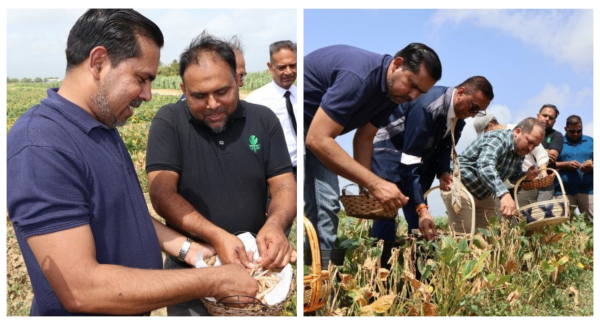
 St Augustine. The Caribbean Agricultural Research and Development Institute (CARDI), in collaboration with the Ministry of Agriculture and Fisheries, on Tuesday, marked the successful harvest of the Black-Eyed Peas Pilot Project in Warrenville, Trinidad, demonstrating the crop’s strong commercial potential and its possible role in strengthening national food security and supporting school feeding programmes.
The pilot initiative, implemented with support from the Ministry of Education, the National School Dietary Services Limited (NSDSL), FAO Caribbean and IICA, showcased the successful adaptation of black-eyed peas under local growing conditions, with CARDI reporting germination rates exceeding 96 percent and harvest achieved within approximately 56 to 60 days.
Minister of Agriculture and Fisheries, Ravi Ratiram, described the initiative as a practical step toward transforming discussions on food security into measurable action.
“Today is about moving from discussion to action on food security,” the Minister said. “The information gathered from these trial plots allows us to confidently advise farmers on the production potential, suitability, and profitability of crops like black-eyed peas under local conditions.”
Ratiram noted that reducing dependence on imported food and agricultural inputs remains a major national priority and commended the collaboration among CARDI, farmers, technical officers, and institutional stakeholders.
Speaking during the harvest exercise, Executive Director of CARDI, Ansari Hosein, said the initiative demonstrated how local production could help reduce food imports while creating new economic opportunities for farmers.
“We have heard that there is over 300,000 kilograms of black-eyed beans being used in the school feeding programme,” Hosein explained. “This is an opportunity where, once we demonstrate profitability and farmers adopt the technology package, we can satisfy that local requirement instead of importing the product.”
He added that the project could support employment generation, reduce foreign exchange outflows, and promote a more circular local economy.
“Everything is grown locally, produced locally, and used locally. Black-eyed beans are also a healthy commodity to consume, which contributes positively to nutrition and reducing non-communicable diseases,” Hosein said.
CARDI Technical Manager, Fayaz Shah, highlighted several important lessons learned during the pilot phase, including the importance of early soil treatment, irrigation scheduling, preventative pest and disease management, and timely fertilizer application.
According to Shah, approximately two acres of black-eyed peas were cultivated as part of the broader six-acre demonstration area, alongside corn and soybean plots. The pilot also demonstrated that local production timelines could outperform some international benchmarks.
“Based on guidance from our counterparts abroad, we expected harvest around 90 days, but under local conditions we achieved harvest readiness in approximately 56 to 60 days,” Shah said. “That tells us the production potential here in Trinidad and Tobago is extremely promising.”
CARDI representatives also conducted technical presentations and live harvest demonstrations for farmers, ministry officials, educators, and other stakeholders attending the event.
The project forms part of broader regional efforts to improve agricultural resilience, strengthen local food systems, reduce the Caribbean’s high food import bill, and support sustainable nutrition initiatives within schools and communities.
Stakeholders noted that locally produced black-eyed peas could eventually contribute to institutional feeding programmes while creating new market opportunities for farmers and agribusiness operators across Trinidad and Tobago.