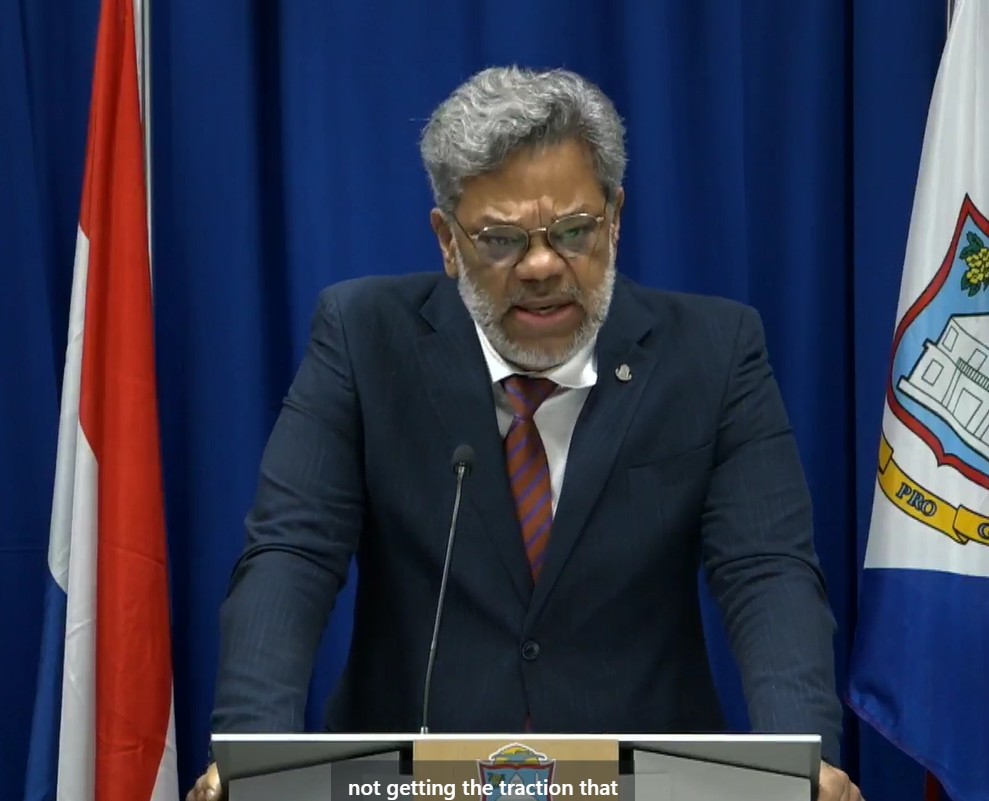
 PHILIPSBURG:--- During the weekly press briefing, Prime Minister Dr. Luc Mercelina announced a historic step toward strengthening patient safety and professional standards with the introduction of a National Healthcare Professional Registry (HCPR). The Prime Minister described the new registry as a long-overdue reform aimed at improving healthcare quality for the people of St. Maarten.
Dr. Mercelina explained that over the years, the absence of a unified national system has led to ongoing confusion and limitations in recognizing qualified healthcare providers. “It is important for St. Maarten to have clarity on who is authorized to provide medical care in the country and what qualifications are required,” he stated. The current gap has at times created challenges that put patient safety and public trust at risk.
A particular challenge has been the reliance on international models, such as the Dutch BIG legislation. The Prime Minister noted that if the BIG law were strictly implemented, many competent doctors, even those who studied in other parts of Europe, would not qualify for registration in St. Maarten. “We’ve seen cases where highly qualified specialists from abroad, including European-trained doctors outside the Netherlands, were unable to practice here because their credentials were not recognized under the BIG requirements,” Mercelina said. This has sometimes forced the country to turn away much-needed expertise and has even led to situations in which specialists could operate elsewhere but not in St. Maarten due to legal technicalities.
Reflecting on this, Dr. Mercelina emphasized that HCPR is designed to address these long-standing barriers. The new registry will be custom-made for St. Maarten, ensuring local needs and realities are front and center. The HCPR will not only clarify who is authorized to deliver care but also set clear qualification requirements, ensuring a transparent and fair process.
Key Challenges and Context:
The BIG registration system, originating from the Netherlands, has been a significant hurdle for St. Maarten. While the Netherlands has robust educational institutions that ensure the quality of medical professionals, St. Maarten faces a different reality. The island does not have the same influx of medical professionals and must rely on expertise from other countries, such as Colombia and Venezuela.
Dr. Mercelina highlighted the contributions of foreign-trained specialists like Dr. Rojas, Dr. Ramos, and Dr. Pinto, who have been instrumental in providing urological care on the island. Their success underscores the potential of welcoming professionals from diverse backgrounds. However, the current reliance on the Dutch system has made it difficult to attract such talent, as the BICH registration does not address St. Maarten's unique needs.
Additionally, the island's healthcare system requires generalists capable of managing a wide range of medical cases, from trauma to routine surgeries. This contrasts with the highly specialized roles common in larger countries, making it challenging to find professionals who can adapt to St. Maarten's demands. Dr. Mercelina noted that generalists on the island often face situations requiring immediate and versatile responses, without the luxury of academic backup or advanced technology.
Features of the HCPR:
- Mandatory Registration: All healthcare professionals working in St. Maarten must register and periodically re-register.
- Continuous Professional Development: The registry will require ongoing education to ensure professionals remain current with medical advances.
- Competency and Skills Assessments: The system will ensure practitioners maintain high standards by regularly evaluating their skills.
- International Recognition: Importantly, the HCPR will recognize approved foreign medical registers and create an admission pathway for foreign-trained professionals, assessing not only their knowledge and technical expertise but also their familiarity with the local healthcare context.
Development and Implementation:
The development process for the HCPR began in 2019 with extensive consultation from healthcare professionals and reference to international examples. The draft legislation is currently under review at the Ministry of Public Health, Social Development, and Labor (VSA) before proceeding to parliamentary debate and eventual implementation.
Importance of the HCPR:
Dr. Mercelina stressed that the registry is not just a regulatory tool but a commitment to better, safer, and more accountable healthcare. It aims to attract professionals tailored to St. Maarten's unique needs, ensuring the island's healthcare system can meet the demands of its population and the new hospital.
He also emphasized the need for St. Maarten to establish its own legislation to serve its people effectively. “We are part of the kingdom, but we must be able to make legislation that is actually going to be beneficial to serve the people of St. Maarten,” he stated. The HCPR represents a critical reform that will support the medical community and reassure everyone who relies on their care.
Prime Minister Mercelina closed by expressing his personal commitment to seeing the HCPR become law. “This registry is not just a regulatory tool, but a promise to our people for better, safer, and more accountable healthcare in St. Maarten. It is a critical reform that will support our medical community and reassure everyone who relies on their care.”