 ~"Born Here & Born to Be Here" Legislation to end uncertainty for St. Maarten’s undocumented youth~
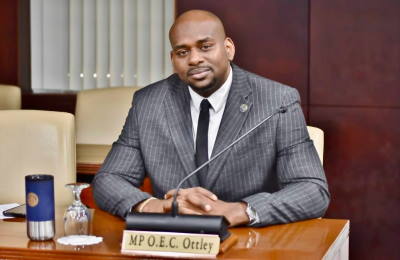
PHILIPSBURG:--- In a passionate address to Parliament, Member of Parliament and Leader of the United People’s Party, Omar E.C. Ottley, presented a landmark legislative initiative designed to resolve the legal limbo facing thousands of children born in St. Maarten.
The draft legislation, themed “Born Here & Born to Be Here,” proposes critical amendments to the National Ordinance on admission and expulsion. It aims to formalize the rights of children who, despite being born and raised on the island, remain undocumented and marginalized due to gaps in the current legal framework.
A Crisis of Identity and Opportunity
The urgency of the legislation is underscored by data from a 2020 UNICEF report, which estimates that approximately 20% of the island's child population is undocumented. MP Ottley emphasized that this issue is not about opening the floodgates for general immigration but is strictly focused on children born on St. Maarten soil.
"I realized that every member of Parliament who spoke, the door was cracked open, and everybody wanted to bust through and wanted me to fix every immigration problem. That's not the essence of this article," Ottley clarified during the parliamentary debate. "We are dealing with children born in St. Martin to foreign parents."
Ottley shared real-life examples of the human cost of this bureaucratic invisibility:
- Shemar, a 15-year-old boxer, is unable to represent his country in regional tournaments because he lacks identification.
- Amber, an 18-year-old graduate, was blocked from pursuing higher education in the Netherlands.
- Jean, a 16-year-old who remains undocumented despite his parents working on the island for 15 years, is simply because an employer missed a permit renewal deadline.
The Proposed Solutions
The draft law introduces a two-pronged approach to provide pathways to residency while addressing concerns about "anchor babies" and ensuring parental contribution to society.
1. Educational Consistency Over "Continuous Admission" (Article 3'i ‘i’)
Currently, children born to non-Dutch parents can gain residency at age 16 if they have been "continuously admitted." The proposed amendment lowers this age to 10.
Crucially, it removes the vague requirement of "admission," which often penalizes children for their parents' administrative lapses. Instead, the focus shifts to the child's presence. Ottley explained that this change is "solely based on educational consistency." If a child can prove they have lived and attended school in St. Maarten since birth, they become eligible. "The parent does not affect that," Ottley stated, ensuring children are not punished for the status of their guardians.
2. Rewarding Contribution (Article 3 ‘j’)
To address concerns raised by colleagues, such as MP De Weever's regarding "anchor babies," the legislation imposes a strict requirement on parents. This new pathway grants immediate residency to a child born in St. Maarten only if the parents have fulfilled tax obligations—including income tax and social premiums—for 10 consecutive years before the child's birth.
You have been here, contributed, you made that child, that child will receive immediate residency," Ottley argued. This provision ensures that the law benefits families who are deeply invested in the island's economy and society.
Overcoming Political and Bureaucratic Hurdles
During his presentation, MP Ottley expressed frustration with the lack of available government data and the slow pace of the legislative process. He noted that, while he requested data on stateless versus undocumented populations from the Prime Minister and relevant ministries, the responses were ofOttley also addressed the friction regarding the law's timeline, pushing back against claims that the process was rushed. He highlighted that the draft was sent to the government in September and has been at the Social Economic Council (SER) for over a year.
"I do not play with the people's business," Ottley said, defending the thoroughness of his work. "We take the same money that I work for... and work tirelessly with my staff to create a law."
He urged his colleagues to look past political lines and focus on the legislation's intent. "Today is our official attempt to make the unwritten policy law to ensure that the rights of our children born here are protected."
A Question of Morality
The legislation represents a shift from discretionary ministerial policies to codified law. Ottley noted that while previous ministers have applied unwritten policies to help these children, such discretionary power leaves the youth vulnerable to the whims of changing administrations.
Closing his presentation with a call to conscience, MP Ottley stated, "A nation's morality is revealed by whose suffering it chooses to ignore. I will not be one to ignore the suffering of the people."