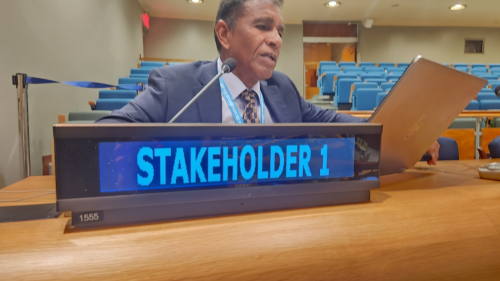
James Finies announces Historic UN Development: Bonaire Draft Resolution Formally Registered at the 80th United Nations General Assembly.

jamesfinies02062026BONAIRE:  1 July 2026, James Finies announces to the people of Bonaire that, in recognition of the abolition of slavery in 1863 in the colonized Antillean islands of the Caribbean, the Bonaire Draft Resolution, sponsored by two Caribbean CARICOM countries, was formally submitted and registered into the administrative process of the 80th United Nations General Assembly on 10th June 2026.

Since 1955, when Bonaire and the former Netherlands Antilles islands were removed by the Netherlands from the United Nations List of Non-Self-Governing Territories (NSGT), this is the most significant step taken toward a major constitutional action concerning the colonized Dutch Caribbean islands.

This Bonaire Draft Resolution urges recognition that Bonaire remains a Non-Self-Governing Territory within the meaning of the Charter of the United Nations and declares that an obligation exists under Article 73 of the Charter on the part of the Kingdom of the Netherlands, as the administering Power of the Territory of Bonaire, to transmit information on Bonaire. It further requests the Special Committee on Decolonization to consider the question of Bonaire at its next session and to report thereon to the General Assembly at its eighty-first session. The draft proposal was uploaded by the United Nations General Assembly Secretariat for worldwide access, including the 193 Member States of the United Nations, through the e-Delegate system.

What does this mean for Bonaire? It means that the Netherlands will be obligated to be accountable and report to the United Nations General Assembly on the social, economic, cultural, political, and educational development of the native Bonerian people, in accordance with the Charter of the United Nations and the treaties that the Netherlands agreed to and signed in 1945. This has happened only three times in world history: in New Caledonia in 1986, French Polynesia in 2013, and now, for the first time in this part of the world, with Bonaire in June 2026.

How did this happen? From 2003 to 2010, James Finies stood up, publicly objected, and voiced his opposition to the divisive and polarizing direction in which Bonairean and Antillean politicians were heading. From 2010 to 2016, James Finies abandoned his lifelong career as a commercial banker and became a full-time volunteer human rights defender on Bonaire and throughout the Antilles, advocating for a referendum and the right to self-determination. Following the failure to respect Bonaire's 2015 referendum, James Finies, from 2016 to 2026, embarked on an international trajectory of continuous awareness-raising and lobbying missions throughout the Caribbean, Central and Latin America, Europe, and the United Nations in Geneva and New York, advocating for the re-listing of Bonaire under the protection of the United Nations.

The advocacy group led by Mr. Finies is the only organization that has consistently worked, from 2003 to the present day in 2026, to highlight and justify the need for the international community to intervene in Bonaire and the wider Dutch Caribbean islands as part of a civil society effort.

Why Bonaire? - The people of Bonaire were left unprotected and abandoned by the CAS islands when Curaçao, Aruba, and St. Maarten, together with the Netherlands, following the dissolution of the Netherlands Antilles in 2010, unilaterally removed Bonaire from the protection of the Kingdom Charter. The people of Bonaire were incorporated, against their wishes and without their consent, into the Constitution of the Netherlands, subordinated and placed at the mercy of external rule from The Hague.

Unlike Curaçao, Aruba, St. Maarten, Saba, and St. Eustatius, Bonaire has since developed into a silent but major humanitarian crisis. Bonaire is in a dire situation, facing immediate demographic and cultural erasure. Native Bonerians, who comprised more than 70% of the population before 2010, according to CBS statistics, have been systematically reduced through institutionalized laws and policies to under 30% today, with predictions that within ten years, by 2035, they will account for less than 15% of the population but fortunately Bonaire possess large diaspora in the Dutch Kingdom. This places the Bonerians at risk of imminent eradication over the next decades if the world and the international community do not intervene to protect the Bonerian people. 

James Finies - Bonaire


Megaleios publishes white paper “How to Fix a Utility Company”

coverutilty01072026PHILIPSBURG:--- Megaleios Communications + Consultancy has published How to Fix a Utility Company, a governance white paper examining N.V. GEBE as a live case study in utility governance, reliability, public trust, financial transparency, and institutional recovery.
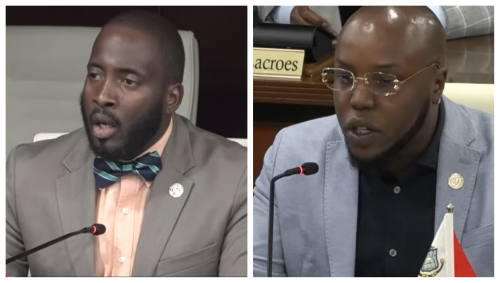
When a utility company struggles, the damage is not limited to engines, invoices, or boardrooms. It reaches homes, businesses, schools, hospitals, workers, investors, and the confidence people place in public institutions.

The paper brings together reports, headlines, court cases, complaints, policy documents, and public information to provide a wider view of the crisis facing GEBE. Its purpose is not to attack anyone, but to help shift the conversation from blame to repair.

“As a researcher, I kept noticing the same patterns across government-owned companies on St. Maarten: instability, weak oversight, public frustration, and accountability gaps,” said Ralph Cantave, founder of Megaleios Communications + Consultancy. “There was a need to bring the facts together in a way that offered clarity, depth, and understanding.”

The paper argues that the cycle of instability, billing chaos, power outages, and accountability failures at GEBE is a governance problem, not only a technical one. It also makes a clear point: new engines are necessary, but they are not enough on their own.

A sustainable utility recovery also requires stable leadership, a competent and independent Supervisory Board, current audited financial statements, credible tariff information, structured complaint handling, lawful accountability, and a realistic plan for energy and water transition.

The paper provides a practical public framework for resolving the crisis. It is written for current and future leadership, the regulator, Government, Parliament, and the wider public. It also supports public discourse from an informed position and sheds light on factors and perspectives that have not always been considered.

The paper was prepared over approximately three weeks through research, review, drafting, and refinement, including reports, policy documents, articles, and publicly available information. It has also been sent to key stakeholders because the conversation must move from frustration to repair.

How to Fix a Utility Company is not an official audit report and does not provide a formal audit opinion. It is a public-interest governance paper intended to support clearer decisions, stronger accountability, and institutional recovery.

A utility turnaround is not a single procurement exercise. It is a governance reset, a financial reset, a communication reset, and a public trust reset.

The paper is now publicly available on LinkedIn via: https://tinyurl.com/fixgebe

Lewis, Doran press for urgent justice debate.

~Opposition MPs demand Justice Minister appear before Parliament over fatal crash, prosecution concerns~

lewisdoran29062026PHILIPSBURG:---  Calls are mounting within Parliament for the Minister of Justice to urgently appear before Members of Parliament following growing public concern over the handling of recent criminal justice matters, particularly the fatal June 11 traffic collision that claimed the life of Ryan Gumbs.
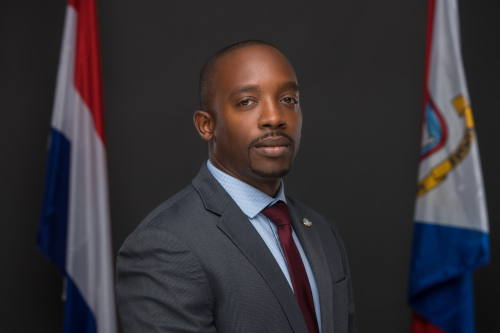
Opposition MP Lyndon Lewis raised the issue during Monday's notifications, expressing frustration that an urgent meeting he requested last week has yet to be added to Parliament's agenda.

"I sent an urgent meeting request last week for the Minister of Justice to be called here in Parliament," Lewis said, adding that after reviewing this week's parliamentary schedule, he was disappointed to find no meeting had been scheduled.

Lewis questioned whether the request had been received by the Chair and stressed that the matter demanded immediate parliamentary attention.

"I find it unfortunate that we are not taking the people's business seriously, and it's about time we take it seriously," he declared.

The MP also reminded Parliament that the Minister of Justice had received a series of parliamentary questions approximately two months ago and had committed to responding within three weeks, in accordance with the Rules of Order.

Appealing directly to the Chair of Parliament, Lewis urged that urgent requests submitted by Members of Parliament—particularly those from the Opposition—receive the prompt attention they deserve.

The call was later reinforced by MP Egbert Jurendy Doran, who devoted much of his notification to the controversial handling of the investigation into the fatal traffic accident.

Doran said he deliberately waited several days before speaking publicly because he wanted to understand the facts surrounding the case. However, after reading the Prosecutor's Office statement, he felt compelled to raise what he described as serious concerns.

Among the issues highlighted by Doran was the Prosecutor's Office's statement that no surveillance footage of the accident exists, and that it made no public appeal for witnesses.

"In every case... drug cases, everything... they ask anyone with information to come forward. That's not the case here," Doran observed.

The former Minister of Justice also questioned the decision to release the suspect from pre-trial detention before transferring him to Immigration and Border Protection Services.

Doran reminded Parliament that deportation orders require ministerial approval and questioned how the country intends to ensure a future criminal trial if the suspect is deported to his home country.

"How are you going to bring back somebody from their native country if we don't have those kinds of agreements?" he asked.

Describing the situation as sending "a bad, bad, bad message," Doran warned that public confidence in the justice system is being undermined.

He threw his full support behind Lewis' request for an urgent parliamentary meeting.

"I see that a meeting was called to discuss these things... if it's not urgent to you, I would like to say it's urgent to me; it's urgent to our faction as well as those that requested," Doran stated.

The coordinated interventions from Lewis and Doran signal increasing political pressure on the Ministry of Justice to publicly explain the handling of the fatal crash investigation, the suspect's release, and the legal procedures surrounding deportation while criminal proceedings remain pending.

IRION urges parliament to set firm budget timeline.

~Says civil servants deserve certainty instead of waiting for the government's schedule~

ardwellirion29042025PHILIPSBURG:--- Member of Parliament Ardwell Irion has called on Parliament to establish firm dates for the continuation of the 2026 budget debate, saying civil servants should not be left in limbo because of uncertainty surrounding the parliamentary schedule.
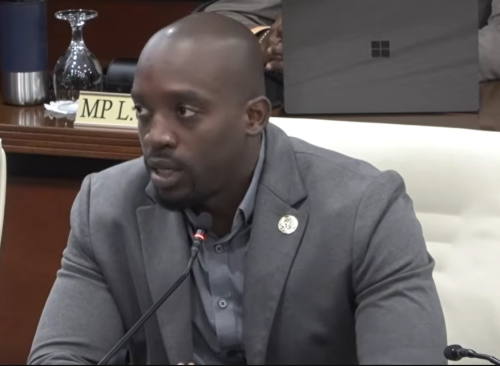
In Monday's notifications, Irion said several civil servants had expressed concern after comments suggesting Parliament could reconvene in the third or fourth week of July without a definite timetable.

According to the MP, the uncertainty has created frustration among public servants attempting to plan vacations and family trips during the summer.

Irion argued that Parliament—not the Executive Branch—must determine its own schedule.

"We don't work for government. Government is accountable to us," Irion reminded the Chair.

He criticized what he described as inefficiencies in the planning of this year's budget process, saying Parliament should establish clear deadlines rather than waiting indefinitely for the government to indicate when it is ready to continue.

"The presidium, the whole organizing of this budget, the inefficiency, the not giving dates... I believe we should be able to tell civil servants, 'On this date we will come back,'" Irion stated.

The MP noted that during normal budget debates there is generally an established schedule, allowing both Members of Parliament and civil servants to plan accordingly.

He urged that before Monday's meeting concludes, Parliament should adopt a definitive roadmap for the remaining stages of the budget process.

"I hope that at the end of today we can really establish the way forward," Irion concluded.

Beyond the procedural issue, Irion's remarks touched on the broader relationship between Parliament and the Executive, stressing that legislative oversight should not be dictated by the government's availability, but by Parliament's constitutional responsibility to hold the Executive accountable.

Irion questions legality of Ministries collecting Government Revenue.

~MP demands explanation after civil servants raise concerns over Finance responsibilities~

ardwelliron29062026PHILIPSBURG:---  Member of Parliament Ardwell Irion has publicly questioned whether two government ministries may have been exercising powers that legally belong to the Receiver's Office, raising concerns over the management of government revenue collection.

Speaking during the notifications segment of Monday's Central Committee meeting, Irion said civil servants had approached him with concerns that the Ministries of TEATT and VROMI had, for several months, been performing revenue collection functions normally assigned to the Receiver's Office within the Ministry of Finance.

Addressing Finance Minister Marinka Gumbs directly, Irion called for a clear explanation of the legal authority behind the arrangement.

"I want to understand what the legal basis was for that," Irion stated, emphasizing that government should never execute administrative decisions without ensuring they are supported by law.

The MP questioned who authorized the transfer of responsibilities and whether legislation or regulations permitted such a move.

"I don't want us in government to be doing things, and then when we look, we do it and execute, that there was actually no legal basis for that to happen," he warned.

Irion further questioned why, after reportedly experiencing operational problems, responsibility now appears to be shifting back to the Ministry of Finance.

"So who made this decision? Why? And show me where there's a legal basis for that," he said.

His remarks place renewed focus on internal government procedures and accountability, particularly at a time when Parliament is scrutinizing the country's financial management during the ongoing 2026 budget discussions.

Should the concerns prove justified, Parliament may seek additional clarification from the Minister of Finance regarding whether statutory responsibilities were reassigned without the necessary legal framework.

The issue now adds another layer to the budget debate, where lawmakers continue to examine government governance, transparency, and compliance with existing financial legislation.


Subcategories